He called AGI for 2030, in 1988. The compute-boom math, fact-checked
A French investor’s five-year thesis says computing power is becoming the economy’s scarcest asset. The 1988 prediction at its heart checks out, and so, mostly, do the GPU numbers.
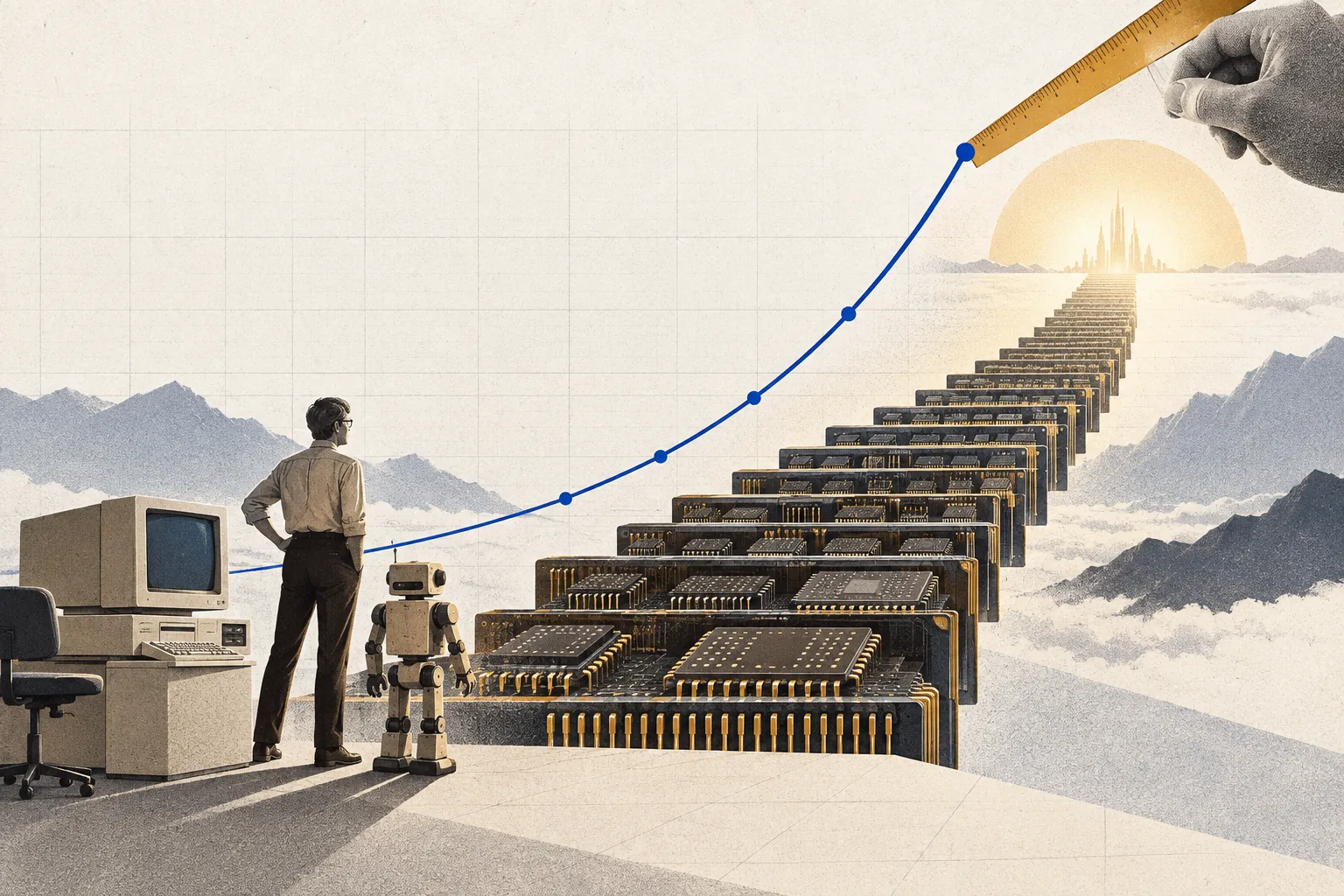
A French video making the rounds lays out a five-year thesis: computing power is on its way to becoming the economy’s most valuable asset, more valuable, per unit of output, than human labour. The video is also a fundraising pitch for the speaker’s own compute-investment vehicle; we have deliberately left the offer out and checked only the thesis. What is left is genuinely interesting.
The argument runs in one long chain. The universe has spent 13.8 billion years building systems that push more energy through less mass, a real metric from astrophysicist Eric Chaisson. Roboticist Hans Moravec used compute curves in 1988 to call human-level AI for around 2030. GPUs are the newest link in that chain, AI has started writing its own code, and demand for compute now outruns supply so hard that even old GPUs are getting more expensive.
Extraordinary chains deserve link-by-link checking, and this one survives it better than most. The 1988 prediction is real and on the record, the Tesla claim is stronger than the speaker made it, and the GPU price data is verifiable. The speculative leaps are real too; we label each one below.
The chain, checked link by link
1. The cosmic “scaling law”, a real metric, honestly stretched
Eric Chaisson, an astrophysicist at Harvard and Tufts, really did propose measuring complexity by energy rate density, energy flowing through a system per unit of time and mass, and showed it rising from galaxies to stars to plants, animals, brains and societies. Calling it “a scaling law observed over 13.8 billion years”, as the video does, is poetry rather than physics: Chaisson himself presents it as an observed empirical regularity, not a demonstrated law, and the video concedes this. A GPU does fit the pattern: it takes in energy and matter, produces ordered information, and exports heat.
2. Moravec’s 1988 bet, real, published, and roughly right
In Mind Children (Harvard University Press, 1988), robotics researcher Hans Moravec extrapolated compute-price curves and predicted human-level AI around 2028–2030, forty years out, before the modern internet existed. His method was the “retinal equivalence” the video describes: estimate the retina’s processing (about ten million-point images per second, roughly 1,000 MIPS), scale by the brain-to-retina ratio, and extend the hardware curve. One correction: in his published 1997 paper the multiplier is 100,000× (the brain’s volume ratio), giving ~100 million MIPS, not the 10,000× the transcript recalls. Moravec noted that being wrong by a factor of 1,000 would shift the date by only about 20 years; that robustness is the actual genius of the estimate.
3. Kurzweil’s dates, accurately quoted, still speculative
Ray Kurzweil refined similar curves in The Age of Spiritual Machines (1999) and The Singularity Is Near (2005): human-level AI passing a Turing test by 2029, and a “singularity” around 2045, when he claims non-biological intelligence will be roughly a billion times more capable than all human intelligence combined. The video quotes him correctly. Whether the 2045 figure means anything is another matter: it is an extrapolated claim from the 2005 book, not a measurement, and mainstream forecasters remain far more spread out (see our AGI Clock for the sourced range).
4. “Claude writes 80% of Claude”, confirmed, with a disclosure
The video attributes to Anthropic CEO Dario Amodei the claim that Claude now writes 80% of Claude’s code. That matches the public record: Anthropic disclosed in May 2026 that more than 80% of code merged into its production systems is written by Claude, with over 90% for its newest models and some internal products effectively 100%. Anthropic itself insists this is not yet recursive self-improvement, humans still direct, review and gate the work. Disclosure: our own knowledge base recommends Claude among other tools, so read our enthusiasm accordingly.
5. Tesla worth more than the big automakers, true, and understated
The video offers Tesla’s valuation as evidence that markets price AI companies, not car companies. The claim checks out stronger than stated: as of mid-2026, Tesla’s market capitalisation (about $1.4 trillion) exceeded the next 37 vehicle and parts manufacturers combined (about $1.42 trillion at the time of that comparison), per contemporary market-data reporting. Toyota, the number two, sits near $250 billion. Whether that valuation is wisdom or mania is exactly the question; the video treats it as evidence while conceding markets can be wrong.
6. GPUs refusing to commoditise, the data backs the observation, not the conclusion
The video’s most concrete claim: rental prices for many GPUs are rising again, including older models. Verifiable and true: SemiAnalysis’s H100 one-year rental index rose almost 40% from about $1.70/hr in October 2025 to $2.35/hr by March 2026; spot H100 rates moved above $2 toward $3 during 2026; B200s climbed; and even the older A100 generation firmed, with providers across generations reporting sold-out capacity. The speculative leap is what comes next: the speaker’s belief that commoditisation will hit the broader economy rather than GPU prices is, as he says himself, a belief. His 20-times-demand-over-supply figure is his own company’s and unverifiable, and his anonymous accounting-automation anecdote is likewise his account, consistent with the verified shortage data, but not evidence.
The honest summary: the checkable links in this chain hold. A 1988 prediction of human-level AI by ~2030, made on hardware extrapolation alone, is aging remarkably well; AI genuinely is writing most of its maker’s code; and compute genuinely is scarce enough that second-hand silicon appreciates. Those are unusual facts for any technology, and they are the strongest part of the thesis.
The conclusion, that owned computing power becomes the premier store of economic value over five years, does not follow automatically. Efficiency gains, algorithmic progress that cuts compute per task, or a plain investment bust would each break the chain, and the speaker making the argument is raising money for it. We checked his math, not his offer; nothing here is investment advice.
Questions people ask
- Did anyone predict AGI before deep learning existed?
- Yes. Hans Moravec’s 1988 book Mind Children extrapolated compute-price curves and put human-level AI around 2028–2030, four decades ahead, before the web, GPUs or modern neural networks. Ray Kurzweil refined similar projections in 1999 and 2005, settling on 2029 for human-level AI. Their method was hardware extrapolation, not algorithmic insight, which is what makes its track record striking.
- Why are GPU rental prices rising instead of falling?
- Demand from AI training and inference is outrunning supply across generations. SemiAnalysis’s rental index shows H100 one-year contract prices up nearly 40% between October 2025 and March 2026, with spot rates rising through 2026 and even older A100s firming as providers sell out. Normally hardware commoditises and cheapens; sustained scarcity like this is the anomaly the compute-investment thesis rests on.
- Does AI really write its own code?
- Substantially, at the frontier: Anthropic disclosed in 2026 that Claude writes more than 80% of the code merged into its production systems, over 90% for its newest models. The company itself stresses this is not yet recursive self-improvement, humans still specify, review and approve the work. It is real leverage, not yet a self-improving machine.
- When is the technological singularity supposed to happen?
- Ray Kurzweil’s longstanding answer is 2045, the point where non-biological intelligence, by his extrapolation, vastly exceeds all human intelligence. That is one forecaster’s curve, not a consensus: surveyed experts and forecasting communities put transformative AI anywhere from years to many decades away. Treat any single date as a claim, not a schedule.
Written from an owner-supplied transcript of a French YouTube video (“Ma vision sur l’IA et la puissance de calcul”) in which the speaker presents a five-year compute thesis and pitches an AMF-registered fundraising offer for his own compute-investment vehicle. We deliberately excluded the offer, its terms and its projected returns, and make no comment on them; nothing in this article is investment advice. Figures checked 11 August 2026. Confirmed: Eric Chaisson’s energy-rate-density metric (Cosmic Evolution, 2001); Hans Moravec’s Mind Children (1988) prediction of human-level AI around 2028–2030 and his 1997 paper “When will computer hardware match the human brain?” (retina ≈ 1,000 MIPS, brain ≈ 100,000× retina by volume → ~100 million MIPS); Kurzweil’s 2029/2045 timelines and the billion-fold 2045 claim as stated in The Singularity Is Near (2005); Anthropic’s May 2026 disclosure that Claude writes over 80% of its merged production code (90%+ for newest models), with Anthropic stating this is not yet recursive self-improvement; Tesla’s ~$1.4T market capitalisation exceeding the next 37 automakers combined per 2026 market-data reporting; and SemiAnalysis’s H100 rental index (+~40% from October 2025 to March 2026) plus 2026 reporting of rising prices across GPU generations including the A100. Corrected: the transcript’s retina-to-brain multiplier of 10,000×. Moravec’s published figure is 100,000×; his 1988 point estimate is usually cited as ~2028, within the transcript’s “2020–2030”. The speaker’s claims about his own companies (demand 20× supply, contract values, valuation) are his and unverifiable; his anonymous accounting-automation case study is his account and is labelled as such; a referenced interview with a Silicon Valley priest was omitted as unverifiable from the transcript. Conflict disclosure: TaskNorth’s knowledge base recommends Claude among other AI tools.
Trying to work out which AI tools fit your task? Describe the outcome and get a Blueprint: the tools, the prompt, and the steps, with pricing we verified ourselves.