You get about 22,000 evenings. Most ambitious people waste them.
A former tech CEO’s system for deciding what an evening is for, clock, compass, climate, plus the research finding that relaxing and recovering are not the same thing.
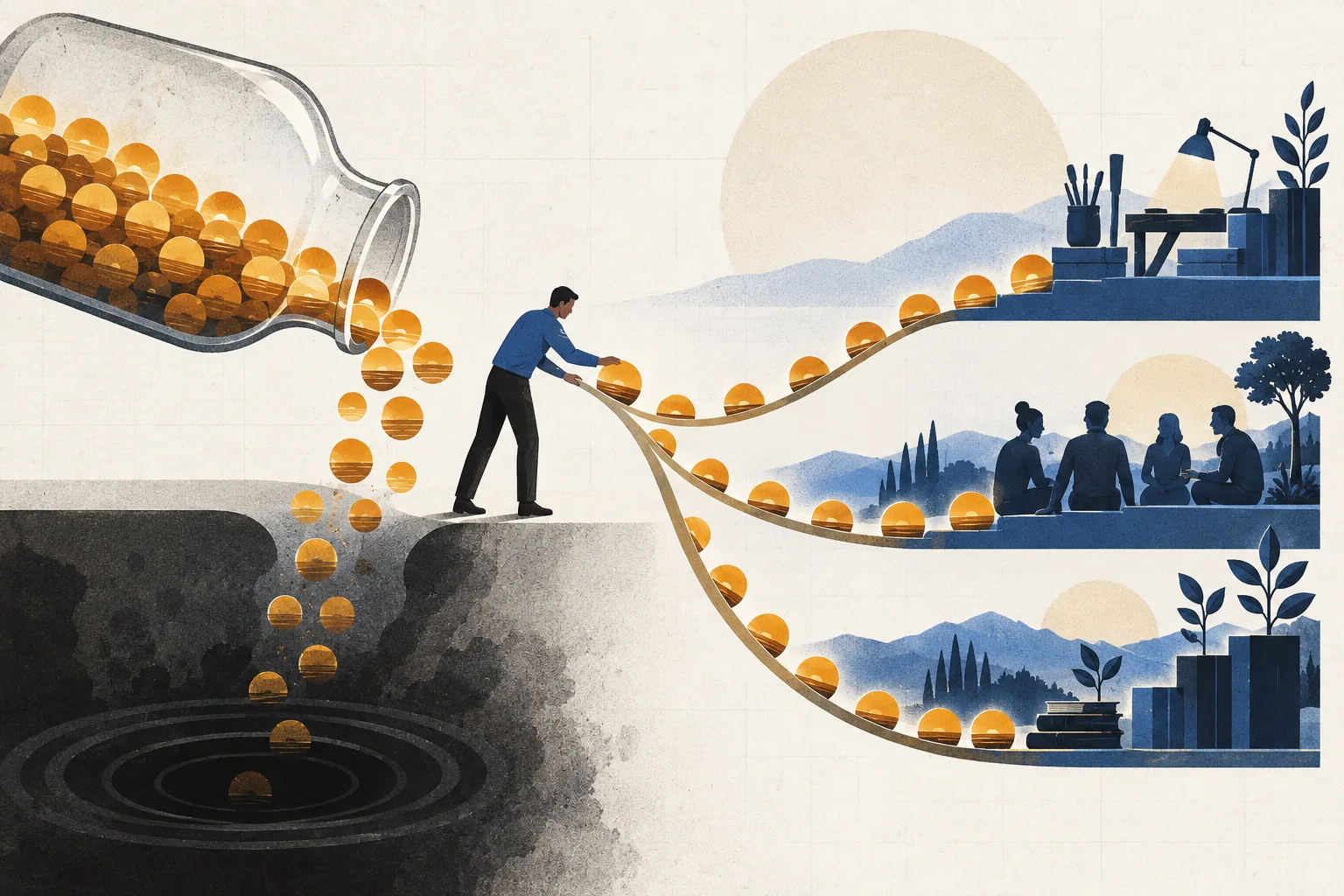
Assume you live to eighty. As an adult that is roughly 22,000 evenings, the entire allotment. The arithmetic behind the framing is the interesting part: a full-time worker’s free hours add up to somewhere near 1,400 a year, against about 45 weeks of actual work. Your after-work time is not a leftover. It is close to a second career hiding inside the same year.
Having the hours is not the same as owning them. From nine to five your role supplies the guardrails, a calendar, a team, a job that tells you where attention goes. At six they vanish, and the default takes over: the Bureau of Labor Statistics puts American leisure at about 5.2 hours a day, of which 2.7 goes to television. More than half of all free time, spent the same way, without anyone deciding.
And unwinding is not the same as recovering. A day-level study in the Journal of Applied Psychology, titled, aptly, “Did You Have a Nice Evening?”, followed workers across a week and found that evening recovery experiences predicted next-morning mood and lower fatigue. After a hard day, something that changes your state restores more than collapsing does. That is not a ban on the sofa. It just means the sofa is not recovery.
Three questions to ask before the evening starts
Clock, what does your biology actually support?
Tim Cook’s 4am is a fact about Tim Cook, not a method; Churchill and Obama did their best work past midnight. You already know your own pattern, when you make clean decisions, when your thinking goes loose and associative, when you start making stupid mistakes. Sharp hours for precision work, loose hours for imagination, depleted hours for closure. Knowing your chronotype is permission to stop following someone else’s clock, not permission to borrow from tomorrow.
Compass, which account is this evening funding?
There are three directions. Physical: health, energy, the capacity to keep going. Emotional: the people who will still be there when the job isn’t. Vocational: skills, projects and relationships that pay off in years rather than tomorrow. Ambitious people reliably over-fund the third. The correction isn’t balance for its own sake, a body you ignored makes success too heavy to carry, and relationships you ignored make it lonely.
Climate, are you in peacetime or wartime?
The same routine is right in one and wrong in the other. When Google’s Gemini 3 landed, OpenAI reportedly declared an internal code red and shelved advertising, shopping and health assistants and its Pulse product to put everything behind ChatGPT. Founders mid-raise, parents of newborns and analysts in earnings season all live in that zone. In peacetime, evenings compound. In wartime they have exactly one job, which is getting you to the other side intact.
When the evening has already gone sideways, late call, sick kid, delayed train, stop chasing the perfect one and aim for an evening that is merely enough. Remove: cut the small decisions, the way a uniform wardrobe cuts them out of a morning. Reflect: two minutes, three fixed questions, asked every night. Rest: protect sleep, and don’t mistake a second wind for a second day.
The sleep part carries the hardest evidence. A study by Harvard Medical School–affiliated researchers, published in PNAS, found that evening use of light-emitting screens suppressed melatonin, delayed the body clock, cut REM sleep and left people less alert the next morning, even after a full night in bed. A short wind-down ritual with the devices left out of it is not a wellness flourish. It is the difference between eight hours and eight useful ones.
None of this is a productivity system in disguise, and the goal is not to extract more output from your night. But it does mark where automation genuinely earns its place: not in filling the evening, but in deleting the recurring admin that eats its first hour, the report you rebuild every week, the inbox triage, the invoice chase. Hand that to a tool precisely so the hours left over are yours to spend on purpose.
Questions people ask
- How much free time does a full-time worker actually get?
- The American Time Use Survey puts leisure and sports at about 5.2 hours a day averaged across all adults and all days, with 2.7 of those hours spent watching television. Working days run lower and non-working days higher; totalled across a year, the commonly cited estimate for a full-time worker lands near 1,400 hours, roughly 35 forty-hour weeks.
- Is relaxing the same as recovering?
- No. Research on day-level recovery, including the Journal of Applied Psychology study “Did You Have a Nice Evening?”, links evening recovery experiences to better mood and less fatigue the following morning. Activities that change your state, exercise, cooking, music, reading, a walk, tend to restore more than passive consumption does, particularly after a stressful day.
- Does screen use before bed really affect sleep?
- Measurably. A PNAS study from Harvard Medical School–affiliated researchers found that reading on light-emitting devices in the evening suppressed melatonin, pushed back the circadian clock, reduced REM sleep and lowered next-morning alertness, even when total time in bed was unchanged.
- What is the 3C evening framework?
- A way of deciding what a given evening is for before it starts. Clock asks what your biology supports at this hour, compass asks which direction the time should fund, physical, emotional or vocational, and climate asks whether you are in a stable stretch where evenings can compound or an intense one where they only need to get you through.
Summarised from a talk on evening design by a former technology CEO and investor; the 3C framework, the personal anecdotes and the “evening bank account” framing are the speaker’s. Verified independently: leisure figures from the Bureau of Labor Statistics American Time Use Survey (about 5.2 hours a day, 2.7 of them television); Sonnentag, Binnewies and Mojza, “Did You Have a Nice Evening?” A Day-Level Study on Recovery Experiences, Sleep, and Affect, Journal of Applied Psychology 93(3), 2008; Chang, Aeschbach, Duffy and Czeisler on evening use of light-emitting eReaders, PNAS 2015, conducted at Brigham and Women’s Hospital and Harvard Medical School; OpenAI’s “code red”, reported from 2 December 2025 by The Information and others, including the postponement of advertising, shopping and health assistants and Pulse. The annual free-hours total is the speaker’s arithmetic over time-use data rather than a figure the BLS publishes directly, and is given as an approximation here.
Trying to work out which AI tools fit your task? Describe the outcome and get a Blueprint: the tools, the prompt, and the steps, with pricing we verified ourselves.