Your AI twin is not you. What transhumanism can actually do in 2026
A new transhumanist survival plan combines preventive medicine, an AI behavioural twin and private compute. The first step is real, the second is useful but limited, and the final promise remains speculation.
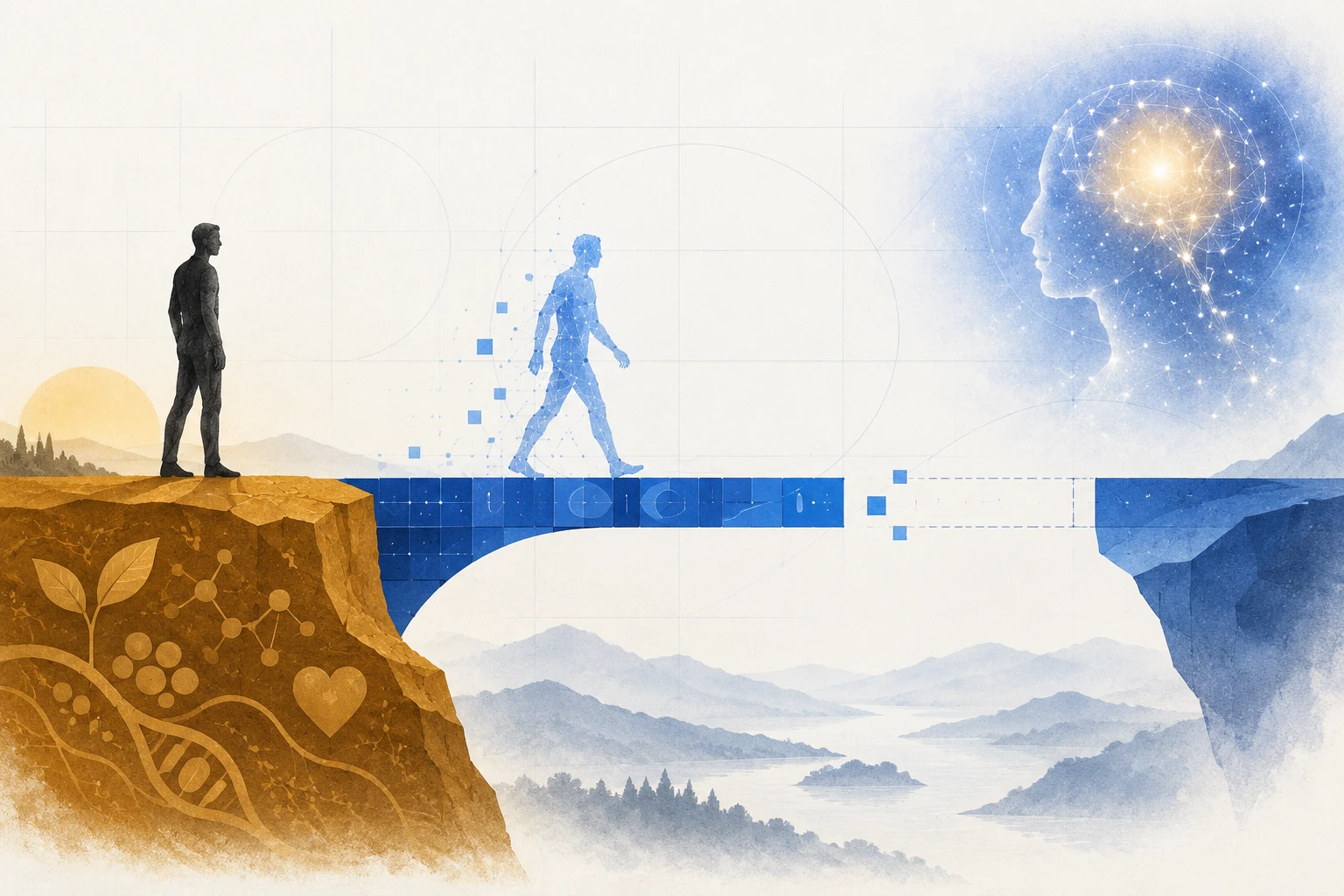
In a 4 October video, Grand Angle Nova founder Richard Détente turns transhumanism into a personal survival strategy. He proposes two tracks: preserve his biological health long enough to reach future breakthroughs, and build an AI twin that can increasingly represent his preferences and perform work. Eventually, he imagines a gradual migration away from the biological body.
Those ideas belong on three different evidence levels. Reducing known health risks and choosing appropriate screening are medicine. Training an agent to imitate some of your answers is an emerging technical capability. Transferring the continuity of a person - their subjective experience, not merely their output - has no demonstrated method, test or success criterion.
The useful question is therefore not whether to believe in transhumanism as one package. It is where each rung of the ladder stands today. The video contains verified examples of accelerating AI, reasonable personal choices, a misread statistic and a large philosophical leap. It also contains financial interests that make the distinction between forecast and product thesis especially important.
From prevention to mind uploading: where the evidence stops
1. METR measures software-task difficulty, not a countdown to superintelligence
METR's 50% time horizon is the human-expert duration of a software task that an agent is predicted to complete successfully half the time. It is not how long the agent runs autonomously, and it does not cover every form of work or intelligence. METR defends a long-run doubling trend of roughly six to seven months; its 2026 risk report fits post-2024 public models at about 105 days. Both results come with uncertainty, benchmark saturation and substantial sensitivity to the agent setup.
2. A thousandfold three-year leap is arithmetic, not a forecast
Extend a 105-day doubling rate for three years and the curve does rise by more than three orders of magnitude. That makes the video's calculation internally understandable. It does not make the extrapolation reliable. METR has explicitly warned that timelines become highly sensitive to whether recent super-exponential growth continues, and its strongest systems were already saturating parts of the test suite. A benchmark trend is evidence of rapid progress; a straight line into 2029 is a scenario.
3. AlphaEvolve is a real AI-improves-AI example - with a bounded loop
Google DeepMind says AlphaEvolve is now used regularly to optimise next-generation TPU design and produced a counterintuitive circuit that was integrated into silicon. That is a consequential feedback loop: AI software helped improve hardware for future AI. It is not an autonomous system choosing its own objectives, manufacturing chips or recursively redesigning itself without engineers and evaluators. The example supports acceleration, not an intelligence explosion by itself.
4. Human spaceflight is biologically hard; 'never interstellar' is still a prediction
NASA groups the central hazards of human spaceflight into radiation, isolation and confinement, distance from Earth, altered gravity and hostile closed environments. Bone loss, immune changes, cancer risk, sleep disruption and limited medical support worsen as missions get longer. Those facts make machines attractive explorers and interstellar human travel extraordinarily difficult. They do not establish that no biological human will ever travel beyond the solar system; the video's certainty goes beyond the evidence.
5. The strongest longevity plan in the video is deliberately ordinary
The transcript correctly rejects a present-day immortality treatment. Its practical core - healthy diet, physical activity, sleep, avoiding tobacco and limiting or avoiding alcohol - targets the same major modifiable risks highlighted by the World Health Organization for cancer, diabetes, cardiovascular and respiratory disease. These behaviours can improve the odds of reaching later life in better health. They do not guarantee survival until a hypothetical rejuvenation breakthrough.
6. Preventive medicine works when the test matches the person
Screening can find some diseases earlier, but more measurement is not automatically more health. Recommendations depend on age, sex, symptoms, family history and other risks because tests also create false positives, incidental findings, overdiagnosis and unnecessary procedures. The American College of Radiology says evidence does not justify total-body MRI screening for asymptomatic people without relevant risks and that no life-extension benefit has been documented. A personalised medical plan is not the same as scanning everything repeatedly.
7. The '10 bits per second' result is narrower than it sounds
A 2024 Neuron perspective estimates that observable human behaviour - typing, speaking, skilled play and similar choice-driven output - operates around 10 bits per second. Its billion-bit comparison comes from the estimated capacity of six million cone cells in one eye, not a measurement that the entire brain consciously processes one billion meaningful bits each second. The paper identifies a striking sensory-to-behaviour bottleneck. It does not provide a file size for a mind or a specification for uploading one.
8. Stanford built behavioural simulations, not digital people
Stanford researchers interviewed 1,052 US participants for two hours and used each transcript to prompt a generative agent. On General Social Survey questions, the agents reproduced responses 85% as accurately as the people reproduced their own answers two weeks later. That is a normalised comparison against imperfect human test-retest consistency - not 85% capture of a personality, memory or future behaviour. The same work reports lower performance on some economic games and warns about privacy, reputation and over-reliance.
9. Imitating your answers does not preserve your continuity
A personal agent can learn writing patterns, preferences and past decisions. If it becomes accurate, other people may experience it as recognisably you. None of that demonstrates that subjective experience moved into the model, that the biological person would experience continuity, or that a gradual handoff avoids the copy problem. Consciousness science still has several competing theories and no agreed complete explanation. Assuming consciousness is unreal because it cannot yet be quantified is a philosophical choice, not a scientific result.
10. Cognitive offloading can expand ability without becoming migration
Calendars, maps, writing and smartphones already let people externalise memory and intentions. Research finds that reminders can be highly effective and can free internal capacity for other information; other studies find weaker retention when people expect an external store to remain available. The effect depends on what is delegated and how the tool is used. An AI that remembers your projects may extend your working system, but dependency on an external tool is not evidence that your identity has left the body.
11. A useful AI twin needs governance before it needs more GPUs
The practical version is a permissioned proxy: source-linked memories, explicit uncertainty, version history, approval gates for consequential actions, exportability and a reliable delete switch. Voice, health records, beliefs and relationship history create an unusually sensitive identity dataset. Owning compute may improve control over infrastructure, but it does not solve consent, impersonation, security or succession. A sovereign server can still host a badly governed copy.
12. The commercial interests are part of the story
Détente says he invested €1 million in preventive-health company Zoī and raised more than $25 million for Promessia, a compute venture for which he describes a one-megawatt Texas site and at least 700 Nvidia GPUs. He presents that infrastructure as a future option for transhumanist services. Those figures were not independently documented in the primary materials we found, so they remain his claims. More importantly, the video is simultaneously a personal philosophy and a founder explaining why his health and compute investments may matter.
The transhumanist ladder has solid lower rungs, an interesting middle and a missing top. Evidence-based prevention can improve health prospects. Personal agents can become useful behavioural proxies. Neither result shows that a person can be copied, migrated or kept alive as software. Calling all three stages one continuous process makes the future feel closer than the evidence warrants.
The honest 2026 strategy is less cinematic: protect health without chasing indiscriminate tests, use AI without surrendering judgment, and treat a personal model as sensitive software rather than a second self. If rejuvenation, brain-computer interfaces or continuity-preserving technologies later cross a measurable threshold, TaskNorth's Immortality Index should move. A convincing chatbot that sounds like its owner is not that threshold.
Where we track this
- The Immortality Index →
A sourced timeline separating measurable longevity progress from speculation about radical life extension.
- The AGI Clock →
Evidence that changes the estimated distance to general machine capability, with every adjustment visible.
- AI is helping build the next AI →
What automated AI research can do today and why it is not recursive self-improvement yet.
- AI's bottleneck is increasingly energy →
Why owning compute is ultimately a bet on electricity, infrastructure and utilisation - not only models.
Questions people ask
- Can AI create a digital twin of a person?
- AI can create a behavioural simulation that imitates some answers, preferences and communication patterns when given enough personal material. Stanford demonstrated this for survey responses using two-hour interviews. That is useful modelling, but it is not a complete copy of the person and does not demonstrate consciousness or identity transfer.
- Is mind uploading scientifically possible today?
- No demonstrated method can upload a human mind or establish that subjective continuity survived a transfer. Researchers do not yet have an agreed complete theory of consciousness, a full readable model of an individual brain or a test that could distinguish continuity from a convincing behavioural copy.
- Does preventive medicine help people live until future longevity treatments arrive?
- Evidence-based prevention can reduce known disease risks and improve healthy-life prospects, but it cannot guarantee that someone reaches a future breakthrough. Screening should be selected with a qualified clinician according to age, symptoms and risk factors because unnecessary testing can also cause harm.
- Does AlphaEvolve prove AI can improve itself?
- It proves a bounded and important form of feedback: Google DeepMind says the agent helped design a circuit used in next-generation TPU silicon. Humans still defined objectives, evaluated candidates and operated the larger engineering and manufacturing process. That is not fully autonomous recursive self-improvement.
- What is cognitive offloading?
- Cognitive offloading means using an external aid - such as notes, calendars, navigation or an AI assistant - to reduce internal memory or processing demands. It can improve task performance and free attention, although reliance on an available external store can also reduce what people retain internally.
Written 6 October 2026 from an owner-supplied French transcript of Grand Angle Nova's 4 October video Je VAIS changer ma vie... grâce au transhumanisme (youtube.com/watch?v=r2Tk5-DdXu8). The video is treated as a personal thesis, not a medical or technical primary source. METR's official Time Horizon page, January limitations note and May 2026 Frontier Risk Report support the definition of the 50% software-task horizon, the long-run six-to-seven-month doubling estimate, the faster 105-day post-2024 fit and the cautions about benchmark saturation, setup sensitivity and extrapolation. Google DeepMind's 7 May AlphaEvolve update supports the claim that an agent-proposed circuit entered next-generation TPU silicon. NASA's Human Research Program supports the five spaceflight-hazard categories and associated health risks; it does not support the absolute claim that biological humans will never travel interstellarly. The prevention section was checked against the World Health Organization's noncommunicable-disease risk framework, the US Preventive Services Task Force's risk-specific approach and the American College of Radiology's statement that total-body MRI is not supported for asymptomatic people without relevant risks. Zoī's own scientific-strategy page confirms that it offers technology-assisted preventive assessment and states that it aims to avoid incidental findings and overmedicalisation; it does not independently verify the speaker's personal investment or outcomes. The 10-bit section was checked against Zheng and Meister's Neuron perspective: the roughly one-gigabit figure describes aggregate cone-photoreceptor capacity in one eye, while 10 bits per second estimates behavioural throughput. The digital-twin figures were checked against Stanford HAI and the underlying Generative Agent Simulations of 1,000 People study: 1,052 participants, two-hour interviews and 85% normalised General Social Survey accuracy relative to human test-retest consistency. That study does not claim consciousness or identity transfer. The consciousness caveat reflects current reviews finding no consensus complete theory; the offloading section reflects a peer-reviewed review of intention offloading and subsequent meta-analytic work. Corrections and limits: the video's 73-versus-18-day model-release statistic has no disclosed inclusion method and is omitted; a three-year thousandfold capability increase is labelled as an extrapolation rather than a forecast; behavioural imitation is not mind uploading; targeted screening is not interchangeable with universal check-ups; and the €1 million Zoī investment, more-than-$25-million Promessia raise, one-megawatt Texas site and 700-GPU inventory remain self-reported because independent primary documentation was not found. The speaker's financial exposure to both preventive health and compute is disclosed because it aligns with the thesis being promoted. This article is editorial analysis, not medical or investment advice; TaskNorth has no commercial relationship with the speaker, Zoī, Promessia, Google, METR or Stanford.
Trying to work out which AI tools fit your task? Describe the outcome and get a Blueprint: the tools, the prompt, and the steps, with pricing we verified ourselves.