The bottleneck was never intelligence. It is electricity, and the data centre is the wrong shape for it
A brand film for a distributed compute company opens on the Texas blackout rather than on a chip, and it is making a serious argument: hyperscale campuses cannot flex, so move the computer to the power instead. The thesis holds. Several of the numbers do not.
The film does not open on a chip. It opens on Texas in February 2021, when ERCOT ordered roughly 20,000 megawatts of rolling blackouts, the largest manually controlled load shed in American history, left about 4.8 million customers dark and disrupted water service for close to half the state. The official toll settled at 246, a figure researchers still call an undercount. The fragile part, the film argues, is the grid.
Then it reaches the number everyone knows. Stargate, announced on 21 January 2025, up to $500 billion over four years. The part fewer people know is what happened next: more than a year on, the joint venture between OpenAI, Oracle and SoftBank was reported to have hired nobody and to be developing no sites of its own, while the partners argued over how the thing should be structured. Capital was never the scarce input.
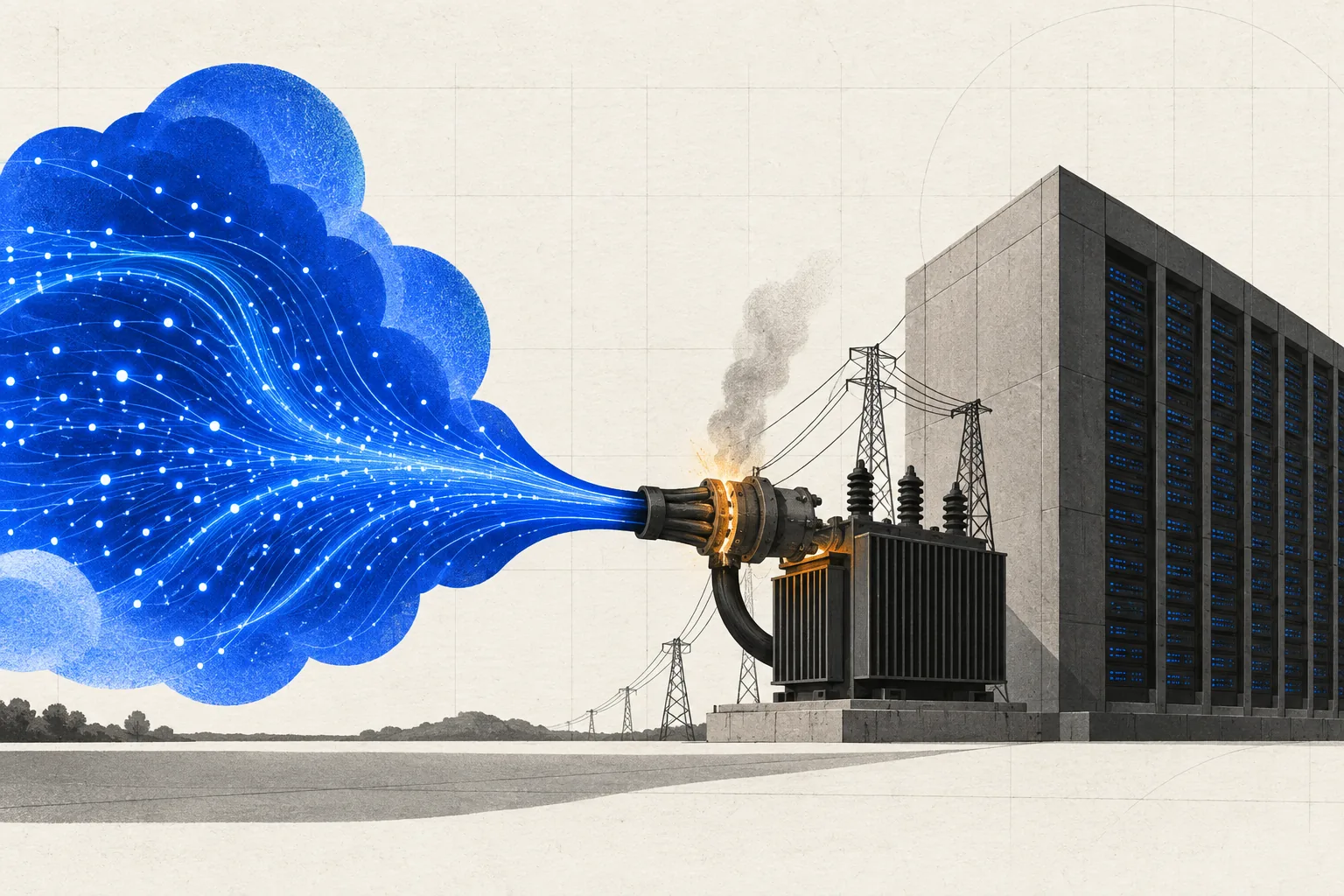
The argument built from there is not that the industry is spending too much. It is that the building is the wrong shape. A hyperscale campus is one enormous bet on one interconnection, and it cannot flex when the grid cannot. So put small units where spare power already sits. The diagnosis is stronger than the pitch that follows it; here is what checks out, and what does not.
What is actually scarce, and where the distributed bet holds up
1. The demand curve, measured properly
The film puts the added load between the launch of ChatGPT and next year at 40 to 50 gigawatts, comparable to a country like France or Germany. That is the speaker’s figure, and it is stated as capacity rather than consumption, so it does not line up with the standard series. The IEA’s numbers are the ones with a published method behind them: data centres at roughly 485 terawatt-hours in 2025, close to 945 by 2030, which is just under 3% of world electricity, and about 1,200 by 2035. Same order of magnitude, different unit, and only one of them is auditable.
2. The part that reaches your own bill
This is the film’s most under-argued beat and the reader’s actual stake. In PJM, the market covering thirteen states and Washington DC, capacity prices for the 2025/26 delivery year rose by a multiple, and published analysis credits data-centre demand with roughly 63% of that increase, about $9.3 billion. Pepco customers in Washington saw residential bills rise around $21 a month from June 2025, with about half of that traced to capacity prices; the estimated effect is near $18 in western Maryland and $16 in Ohio. From June 2026 the region pays roughly $1.4 billion more again.
3. Why a hyperscale campus cannot flex
The design critique is the strongest part of the film. A campus is one interconnection, one permitting fight and one very large fixed bet, with a payback the speaker counts in 25 to 30 years. Treat that as the speaker’s arithmetic; operators do not publish it. The build-time claim is looser still. The film says five to ten years, while the company’s own press release uses 24 months or more for a traditional build against five months for one of its units. The film overstates the very comparison it is selling.
4. The premise underneath: power that already exists and is thrown away
The bet only works if there is stranded generation to find. The company cites about 12 terawatt-hours of renewable electricity curtailed in Europe in 2023, roughly €4.2 billion of value spilled, and more than 1,000 gigawatts of renewable capacity sitting in permitting and grid queues across Europe and the Gulf. Those are company-cited figures rather than independently audited ones. The underlying phenomenon, though, is well documented: generation keeps being built in places the grid cannot yet carry it away from.
5. What has been built, as against what is planned
Antimatter was formed in April 2026 by combining Data Factory for energy, Policloud for the containerised units and Hivenet for the software that pools them. It is headquartered in Cannes and reports €300 million secured. On launch day its own release counted 10 units across 8 sites, 26 megawatts operational, 3,400 GPUs, $20 million of revenue and $4 million of EBIT. In early September 2026 the company reports 40-odd units, 11 sites, 4,200 GPUs and 42 megawatts. That is real growth, and roughly 40% of the 100 units targeted for 2027, not the finished first phase the film implies.
6. The economics, all of it company-reported
The headline claims run: about $7 million of capital expenditure per fully loaded megawatt against about $35 million for hyperscale, pricing around 50% below hyperscalers, roughly 70% lower carbon, no water cooling, sub-10 millisecond latency at the edge, up to 400 GPUs in a unit and five months to deploy. Not one of these has been independently audited, and several are the kind of number that depends entirely on what you choose to count. Treat them as the vendor’s own arithmetic until somebody other than the vendor publishes a comparison.
7. The one claim that does not survive contact
The film says the network is worth the square of its size: a hundred units are worth ten thousand, a thousand are worth a million. That is Metcalfe’s law, contested since Odlyzko and Tilly argued the value of a network grows closer to n log n, and blamed the square law for helping inflate the dot-com and telecom booms. A compute fleet is not a communications network in any case. A GPU in Oregon is worth no more because another exists in Lisbon, except through scheduling, failover and sitting near a user. What a fleet is really judged on is utilisation.
8. Why inference is the workload that can travel
Here the thesis is at its strongest, and it is the reason this is more than a brand film. Training wants one enormous synchronous cluster. Inference does not: it is latency-sensitive, increasingly jurisdiction-sensitive, and it is now the majority of AI compute spend, though the widely quoted 60% to 70% share rests on secondary analysis rather than operator disclosure. Answers, unlike training runs, have to happen near the person waiting for them and under the law that governs their data. That is a genuine reason to spread compute out.
The interesting thing about this argument is that it is the physical form of one we have already made. When the price per token falls and demand climbs to meet it, the constraint does not disappear, it relocates to whatever cannot be copied: wafers, memory, cooling and watts. Watts are the awkward one, because unlike tokens they are local. They have to be permitted, interconnected and paid for by somebody, and that somebody is increasingly a household reading a utility bill. It is how a question about model quality turns into a question about queue position on a grid.
So the honest summary splits in two. The diagnosis is right: energy is the binding constraint, and inference is the part of the workload that can move to meet it. The execution is unproven: roughly forty units against a target of a thousand, every efficiency figure supplied by the company selling them, and a network priced on a law that does not hold. What is worth carrying away is smaller and more durable than the pitch. Where a model runs is becoming part of what it costs, how quickly it answers and whose law governs the data you send it, so choosing a tool is quietly turning into choosing a route.
Questions people ask
- Why are data centres raising my electricity bill?
- Because capacity in wholesale markets is priced against demand. In PJM, which serves thirteen states and Washington DC, capacity prices jumped for the 2025/26 delivery year, and published analysis attributes about 63% of that increase, roughly $9.3 billion, to data-centre demand. It reaches households as monthly bill increases estimated at around $21 for Pepco customers, about $18 in western Maryland and $16 in Ohio.
- How much electricity do AI data centres actually use?
- The IEA’s figures are the ones with a published method: data centres consumed roughly 485 terawatt-hours in 2025 and are projected to reach about 945 by 2030, just under 3% of global electricity, and about 1,200 by 2035. AI is the main driver of that growth. Figures quoted in gigawatts describe capacity rather than consumption, so they are not directly comparable.
- What is a micro data centre?
- A containerised, factory-built unit holding a few hundred servers or GPUs, delivered to a site and connected to power there rather than built as a campus. Antimatter’s units hold up to 400 GPUs, and the company says they take about five months to deploy against 24 months or more for a traditional build. The appeal is siting them beside existing generation instead of waiting in a grid connection queue.
- Is Stargate still happening?
- The programme announced on 21 January 2025 has continued to add planned capacity and committed investment through partner projects, including the Abilene site in Texas. The joint venture itself is a separate question: more than a year after the announcement it was reported to have no staff and no sites under its own development, with OpenAI, Oracle and SoftBank still negotiating how the collaboration should work.
- Are distributed data centres really cheaper than hyperscalers?
- Nobody outside the companies making the claim has shown it. Antimatter reports about $7 million of capital expenditure per fully loaded megawatt against about $35 million for hyperscale, and prices around 50% below hyperscalers. Those are vendor figures, highly sensitive to what is counted, and no independent comparison has been published. The structural argument, that avoiding a grid connection queue saves years, is easier to credit than the specific percentages.
Written 6 September 2026 from an owner-supplied video whose captions are automatically generated and fragmentary in places; every figure was re-verified against primary or first-tier sources on 6 September 2026. Verified directly: ERCOT’s roughly 20,000 MW of manual load shedding, the 4.8 million customers affected and the water-service disruption during the February 2021 freeze, together with the official Texas toll of 246 and the published view that it is an undercount; the Stargate announcement of 21 January 2025 and the 2026 reporting that the joint venture had no staff and no self-developed sites; the IEA’s data-centre consumption series; PJM capacity-price analysis and the residential bill estimates drawn from it; Antimatter’s own launch press release, press kit and website for every company figure, including the April 2026 combination of Data Factory, Policloud and Hivenet, the Cannes headquarters and the launch-day and current operating counts; Odlyzko and Tilly’s refutation of Metcalfe’s law; and the company’s own published line that in the age of AI intelligence is not the bottleneck, energy is. Corrections to the source material: the film’s 40 to 50 GW of added demand is the speaker’s figure and is stated as capacity rather than consumption, so the IEA’s terawatt-hour series is given instead; the film’s five-to-ten-year hyperscale build time contradicts the company’s own press release, which uses 24 months or more; and the film speaks as though the first hundred units are in place, while the company’s current figures put it near forty. Labelled but unconfirmed: every capital-expenditure, price, carbon, latency, deployment-time and stranded-energy figure here is company-reported and has not been independently audited; the 25 to 30 year hyperscale payback is the speaker’s arithmetic; and the 60% to 70% inference share of AI compute rests on secondary analysis rather than operator disclosure. Omitted as unverifiable: speaker attributions in the transcript could not be reliably resolved, so no line here is attributed to a named individual except where it appears in the company’s own published materials. The film refers to a colleague named Richard on the energy side while the company lists Guillaume Goualard as chief executive of Data Factory, and that discrepancy is left unresolved rather than guessed at. Disclosure: Antimatter is not in the TaskNorth knowledge base and no commercial relationship is disclosed; the two earlier TaskNorth articles this one builds on, on the Jevons paradox and on the rival economics of the US and Chinese AI bets, are our own.
Trying to work out which AI tools fit your task? Describe the outcome and get a Blueprint: the tools, the prompt, and the steps, with pricing we verified ourselves.