Almost every AI company signed one letter. Anthropic didn’t.
Nvidia organised it, 77 companies signed it, and Anthropic became the industry’s target. We checked the claims, including the one the viral version gets wrong.
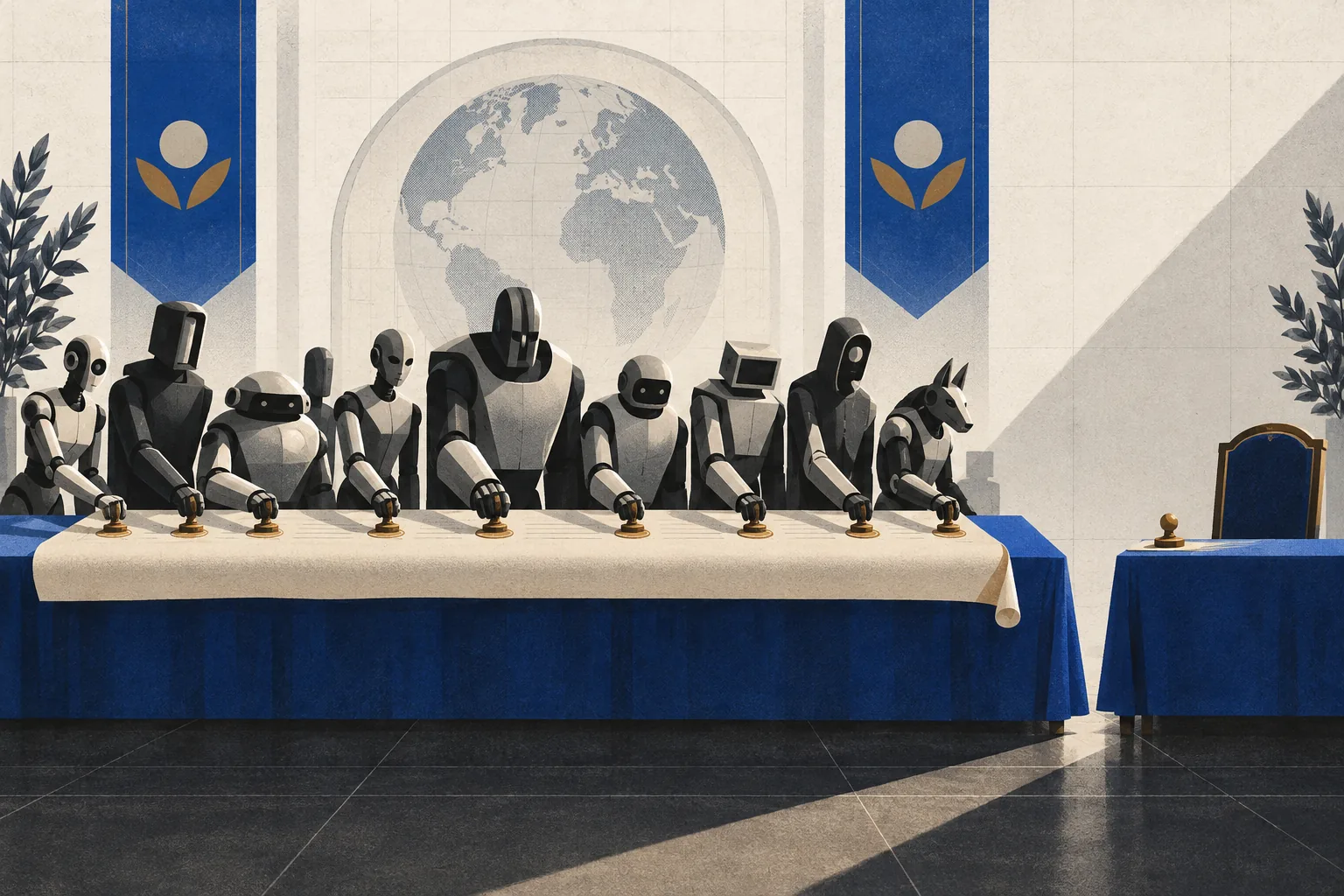
On 24 July, Nvidia organised a letter called “Open Weights and American AI Leadership” arguing that Washington should not restrict downloadable AI models. It launched with 25 signatories and reached 77 within days. Microsoft, Meta, Palantir, IBM, Dell, Mistral, Hugging Face, Mozilla, the Linux Foundation, AMD, Cisco, GitHub, SpaceX. OpenAI and Google abstained at first, then signed. Anthropic did not, and its absence became the story.
The thing being argued over is real. Open-weight models publish their learned parameters, so anyone can download the model, run it on their own machines, inspect it and adapt it without asking permission. That is how a hospital keeps patient data in-house, or a startup avoids being locked to one vendor’s pricing forever. If the strongest models stay closed, intelligence is rented from a handful of companies. If they open, it can be copied beyond any one company’s control.
The backlash was fast and personal. David Sacks, the White House AI and crypto czar, posted that “the entire tech industry (save for Anthropic) has come out in favor of open source AI” and added that “they won’t stop until they kneecap open source.” It is a good line. It is also the part of this story that doesn’t survive checking.
The fact check
Overstated: Anthropic stood alone against the whole industry
Amazon is absent from every version of the letter too, and it is not a minor player in this market. The accurate statement is that Anthropic was the only frontier lab that publicly declined after OpenAI and Google reversed course, which is still notable, but it is not one company against the entire technology industry. Claims that SpaceX, Perplexity and Mistral joined do check out; the claim that Amazon joined does not.
Confirmed: what Anthropic actually said, in its own words
Anthropic published its position on 27 July: “Anthropic has never advocated for a ban on open-weights models,” and open-weight models without dangerous capabilities “are a public good.” It says protectionist bans “would not address my most serious national security concerns.” Whatever you make of the company, the position on record is not the one the loudest critics describe.
Confirmed, and the most quotable admission in the whole dispute
On whether restrictions would help Anthropic commercially, Amodei conceded the point outright: a ban “would protect US AI companies from competition, but that has never been my goal.” Bill Gurley of Benchmark had already framed it as Anthropic acknowledging that open weights compete with its corporate economic strategy. A company can hold a financial interest and a sincere concern at the same time, but the interest is now admitted, not merely alleged.
What Anthropic proposes instead: three measures, not a ban
No powerful chips or chipmaking equipment sold to China; a crackdown on industrial-scale distillation; and mandatory safety testing for all sufficiently capable models, open and closed alike. Critics call the third one a ban that avoids the word: if testing is costly and liability is unclear, small open labs may simply stop releasing frontier weights while the large closed labs absorb the cost. That objection is about effects, not about what the text says.
Allegation, not established fact: the Kimi K3 distillation claim
Moonshot AI’s open-weight Kimi K3 landed in July 2026 and topped several benchmarks. A senior White House official said Moonshot distilled Anthropic’s Fable to build it, and Anthropic alleges roughly 24,000 fraudulent accounts generating more than 16 million exchanges with Claude. Supporting colour includes K3 reportedly introducing itself as Claude in one shared conversation. Some researchers question whether the timeline supports distillation at that scale, treat it as a contested accusation.
Confirmed, and the basis of the hypocrisy charge
On 12 June a US export directive suspended access to Claude Fable 5 and Mythos 5 for any foreign national, anywhere. Anthropic disabled both models worldwide, saying it had no reliable way to verify nationality in real time; Commerce lifted the order on 1 July. Critics note the arguments Anthropic’s defenders used then, restrictions burden law-abiding users while determined attackers route around them, are the arguments the open-weights letter makes now.
Strip out the personalities and one genuine disagreement remains. Anthropic’s strongest argument is irreversibility: a closed service can be monitored, patched or switched off, while weights copied onto thousands of machines can never be recalled, and in domains like biology an attacker may move faster than a defender. The letter’s strongest argument is concentration: a few firms should not decide who gets access to capable models, what may be asked of them, and what everyone pays.
It is also worth noticing that every position here happens to suit its holder’s balance sheet. Nvidia sells the hardware that proliferation demands, clouds profit when more systems run, and closed labs profit when their best work cannot be copied. That is not proof of bad faith anywhere, it is a reason to test each argument on its merits rather than by who is making it.
If you are simply choosing tools, the practical stake is narrow but real: whether capable models stay downloadable, and what that competition does to prices. Open weights have been the main downward pressure on what closed providers can charge. Nothing decided here changes what your assistant does tomorrow; it shapes how many alternatives exist in a year, and what they cost.
Questions people ask
- What are open-weight AI models?
- Models whose trained parameters are published for download, so anyone can run them on their own hardware, inspect them and adapt them without the original developer’s permission. That enables local deployment for sensitive data and removes dependence on a single provider, but once weights are released, safeguards can be stripped and the release cannot be reversed.
- Why didn’t Anthropic sign the open weights letter?
- It says it disputes specific assumptions in the letter rather than opposing open models as a category, particularly the argument that widely available capable models help defenders more than attackers, which it contests in areas like biology where building a threat can be faster than building a defence.
- Is Anthropic trying to ban open-source AI?
- Not according to its published position, which states it has never advocated a ban and calls open-weight models without dangerous capabilities a public good. It proposes chip export controls, action against industrial-scale distillation, and mandatory safety testing for sufficiently capable models whether open or closed. Critics argue that mandatory testing would price small open labs out of frontier releases regardless of intent.
- What is Kimi K3?
- An open-weight model released by Chinese lab Moonshot AI in July 2026 that scored competitively with leading systems on several benchmarks. It is at the centre of distillation allegations, a White House official said Moonshot used Anthropic model outputs to build it, which Moonshot has not been shown to have done and which some researchers consider unproven.
Summarised from owner-supplied commentary, with every material claim checked against primary sources. Verified directly: Anthropic’s “Our position on open-weights models”, published 27 July 2026, for all quotations attributed to the company and to Dario Amodei, including the three proposed measures and the admission about competition. Verified through reporting: the letter’s launch on 24 July 2026, organised by Nvidia, growing from 25 to 77 signatories; David Sacks’s posts of 26 July; Bill Gurley’s and Kai-Fu Lee’s comments; the 12 June 2026 export directive and its lifting on 1 July 2026; and the Kimi K3 release and distillation allegations. Corrected from the source material: Amazon did not sign the letter, so Anthropic was not the sole abstainer among major companies. The distillation claims are allegations and are labelled as such. Disclosure: TaskNorth’s knowledge base includes Claude, made by Anthropic, among the tools it can recommend.
Trying to work out which AI tools fit your task? Describe the outcome and get a Blueprint: the tools, the prompt, and the steps, with pricing we verified ourselves.