OpenAI released 722 AI math manuscripts. What has actually been verified?
OpenAI's internal model produced a catalogue on a scale mathematics has never had to absorb at once. The release is real, the formal proof artifacts matter, and the corrections have already begun. Here is what 722 manuscripts do and do not establish.
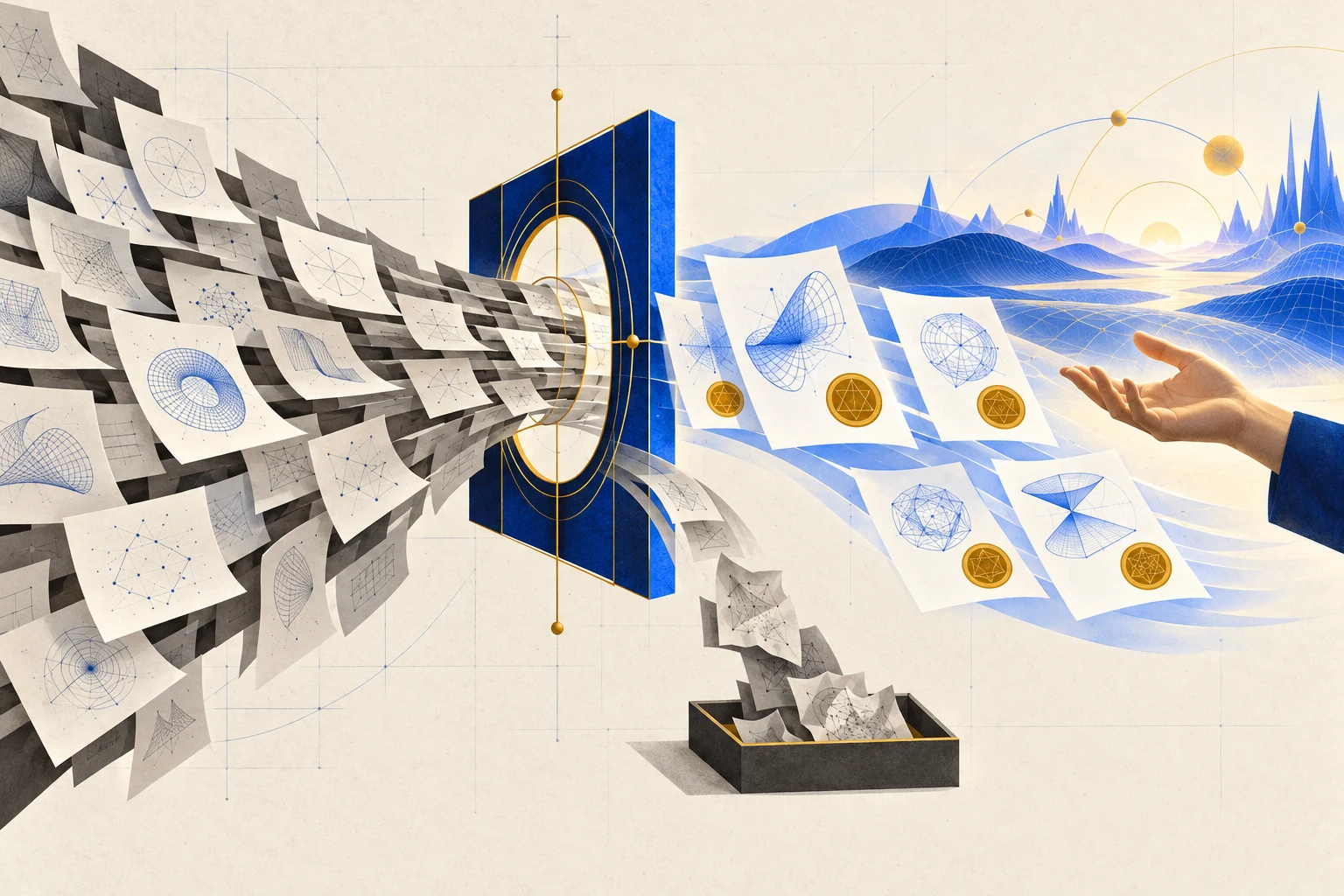
On 6 October 2026, OpenAI placed 722 AI-written mathematics manuscripts on GitHub, grouped into 372 families of related results. The scale is extraordinary: number theory, geometry, analysis, complexity, probability and other fields arrived in one public catalogue, produced mostly by an unreleased internal model that had been given roughly 4,000 research problems.
But 722 manuscripts is not the same as 722 independently confirmed breakthroughs. A family can contain a principal result, companion arguments, consequences or alternative proofs. The live catalogue now contains 719 manuscripts after three withdrawals, and OpenAI explicitly warns that unformalized results may contain issues. Publication opened the audit; it did not finish it.
The strongest evidence is the formal layer. OpenAI reports that 300 of the 719 current top-line results, about 42%, have Lean formalizations that a computer can check. That is much stronger than a plausible-looking PDF, but it still does not automatically certify novelty, significance, exposition, attribution or the match between a headline and the exact formal statement. Those remain human research tasks.
Ten things the release actually tells us
The original release was 722 manuscripts, not 722 separate problems
OpenAI organized the papers into 372 result families. One family may include several manuscripts that develop the same central result through a main proof, an alternative route, supporting lemmas or consequences. Counting papers therefore overstates the number of distinct mathematical questions, while counting families can still understate how many useful results a family contains.
The current catalogue contains 719 manuscripts
On 7 October, OpenAI withdrew three linked papers after finding a sign error that invalidated a stabilization-trace cancellation argument and two dependent constructions. It also revised 14 other manuscripts, then updated 13 more to cite corrected editions. The public history makes the correction process visible, which is valuable evidence and a warning against treating the launch snapshot as final.
The model remains unreleased and largely unnamed
The repository calls it an internal OpenAI model, while the announcement calls it an internal frontier model. OpenAI says most results came from one procedure, with an average compute budget equivalent to roughly three hours of ChatGPT Pro thinking per result. That tells us something about effort, but outsiders cannot yet reproduce the full experiment with the same model.
About 4,000 problems were attempted
OpenAI says the model was posed approximately 4,000 research problems before outputs were filtered and assembled into the catalogue. That denominator matters. It suggests a remarkable yield, but not a system that solves every open question on demand. The repository also identifies exceptions to the standard procedure, including work related to a zeta-function zero-free region and the Hodge conjecture for CM abelian varieties.
Lean changes the quality of the evidence
A Lean proof is expressed in a formal language and checked by a small trusted kernel against explicit definitions and dependencies. That can rule out the informal gaps that often hide inside fluent mathematical prose. OpenAI's catalogue currently reports 300 formalized top-line results out of 719, supported by comparator files intended to connect the checked theorem to the published statement.
Formal verification is not the whole scientific verdict
Lean checks whether the encoded conclusion follows from the encoded assumptions and permitted foundations. It does not decide whether a theorem is genuinely new, whether the assumptions capture the informal claim, whether the result matters, whether related work received proper credit or whether a long proof has been explained in a way humans can reuse. Formal correctness and mathematical understanding overlap, but they are not identical.
Most of the collection still needs conventional scrutiny
Roughly 58% of the current top-line results are not listed as formalized. OpenAI itself says some unformalized results could have issues. For these papers, expert reading, dependency checks, literature searches, reconstruction of arguments and ordinary peer review remain essential. Even the formalized portion needs specialists to assess scope, novelty and importance.
The transparency package is meaningful but incomplete
The repository preserves versions, publishes build and citation materials, provides Lean artifacts and includes ten abridged reasoning summaries. Yet ten traces cover only a small part of the collection, and the exact model is not publicly available. The independent mathematics advisory group had recommended disclosing the model, prompts, summarized reasoning, time and estimated compute for each result.
The bottleneck is moving from generation to assimilation
A research community cannot absorb hundreds of technical manuscripts at machine speed. On 15 October, the Simons Foundation announced a combined $15 million effort with Anthropic and OpenAI to help mathematicians evaluate AI-assisted results, learn the tools and develop shared standards. OpenAI's contribution is $5 million plus model and computing access for supported researchers.
This is evidence of acceleration, not a timestamp for AGI
The release shows that a frontier model can generate a large volume of potentially important work in a formal, highly structured domain. It does not by itself demonstrate reliable autonomy across experiments, institutions, physical systems or everyday judgment. It should move forecasts about AI-assisted science, but any exact claim that AGI or a singularity has arrived goes beyond what this repository proves.
The careful conclusion is still a dramatic one. A proprietary model produced enough research-grade mathematics to create a new institutional problem: how can humans verify, attribute, understand and build on more results than they can read? Three early withdrawals do not erase the catalogue's significance, just as 300 formalizations do not validate every page in it.
Mathematicians are not reduced to checking a machine's homework. Their scarce work becomes even more visible: choosing worthwhile questions, detecting hidden assumptions, relating a proof to existing ideas, creating concepts, teaching intuition and deciding what deserves to become part of shared knowledge. The machine has accelerated theorem production. The harder project is turning output into mathematics.
Explore the source
- OpenAI: Sharing AI progress in mathematics
The official 6 October announcement, including the Lean release, compute estimate and 15 October funding update.
- openai/math on GitHub
The live catalogue, manuscript map, source files, formalization data and production-method notes.
- OpenAI math repository history
The official record of three withdrawals, manuscript repairs and additional formalizations.
- Advisory Group on Mathematics and Artificial Intelligence
The independent group's response to the release and its guidance on transparency, access and human understanding.
- Simons Foundation: $15 million mathematics and AI initiative
The foundation's description of the community-led funding and resource commitment announced on 15 October.
- Hugo Duminil-Copin's 8 October SMF conference
The Société Mathématique de France recording of a Fields Medalist's first-hand reaction to the release and its impact on mathematical research.
Where we track this
- How OpenAI approached the Navier-Stokes problem →
A closer look at the earlier multi-agent research project that preceded the mass mathematics release.
- Why mathematical credit became part of the story →
The authorship and attribution dispute that shows why correctness alone is not the full standard for scientific publication.
- Follow the evidence on TaskNorth's AGI Clock →
Track capability signals without converting one spectacular domain result into a premature claim of general intelligence.
- What coding agents already change in science →
A practical comparison between machine acceleration and the human verification needed for reliable research software.
Questions people ask
- Did OpenAI solve 722 open math problems?
- No. OpenAI originally released 722 manuscripts grouped into 372 families of related results. A family may contain several papers, and the manuscripts are at different stages of verification. The live catalogue contains 719 after three linked papers were withdrawn.
- How many of OpenAI's math results are verified in Lean?
- The repository reports 300 formalized top-line results out of 719 current manuscripts, or about 42%. This is a changing figure, so the repository's README and formalization catalogue are the current sources of truth.
- What does a Lean proof verify?
- Lean checks that a precisely encoded theorem follows from specified assumptions, definitions and dependencies. It can provide exceptionally strong evidence of formal correctness. It does not automatically establish novelty, importance, proper attribution, readable exposition or perfect equivalence between an informal headline and the encoded statement.
- Why did OpenAI withdraw three manuscripts?
- The repository history says a sign error invalidated a stabilization-trace cancellation argument in one paper and the construction used by two dependent papers. OpenAI withdrew all three on 7 October 2026 and preserved links to the archived versions.
- Which model produced the mathematics papers?
- OpenAI describes it as an unreleased internal frontier model and has not provided a public model name in the release. The company says most results used a common procedure averaging the compute equivalent of about three hours of ChatGPT Pro thinking per result.
- Does the release prove that AGI has arrived?
- No. It is strong evidence of rapid progress in advanced mathematical reasoning and research automation. AGI is a broader claim involving robust generalization, autonomy and competence across many environments, so the repository is an important signal rather than a conclusive test.
Written 19 October 2026 from OpenAI's official announcement and the live openai/math repository. Counts were checked against the repository README and history on that date: 722 manuscripts at launch, 719 after three withdrawals, 372 result families, and 300 of 719 top-line results reported as formalized in Lean. TaskNorth did not independently compile the complete Lean library or validate the mathematical novelty of the manuscripts. The article corrects the supplied transcript's repeated framing of 722 manuscripts as 722 fully confirmed solutions, separates family, manuscript and formalization counts, and omits unsupported countdowns to AGI, superhuman IQ figures and other precise forecasts. Reactions and governance context were checked against the Société Mathématique de France, the independent AGMAI statement and the Simons Foundation announcement. TaskNorth has no commercial relationship with OpenAI, Anthropic, the Simons Foundation, AGMAI or the SMF.
Trying to work out which AI tools fit your task? Describe the outcome and get a Blueprint: the tools, the prompt, and the steps, with pricing we verified ourselves.