France did not ban Tesla FSD. Europe is deciding who owns the car's intelligence
France's pause on Tesla's supervised driving system is a real safety dispute, not proof of an anti-technology ban. But it exposes a larger industrial risk: Europe can keep building excellent cars while the software that drives them captures more of the value.
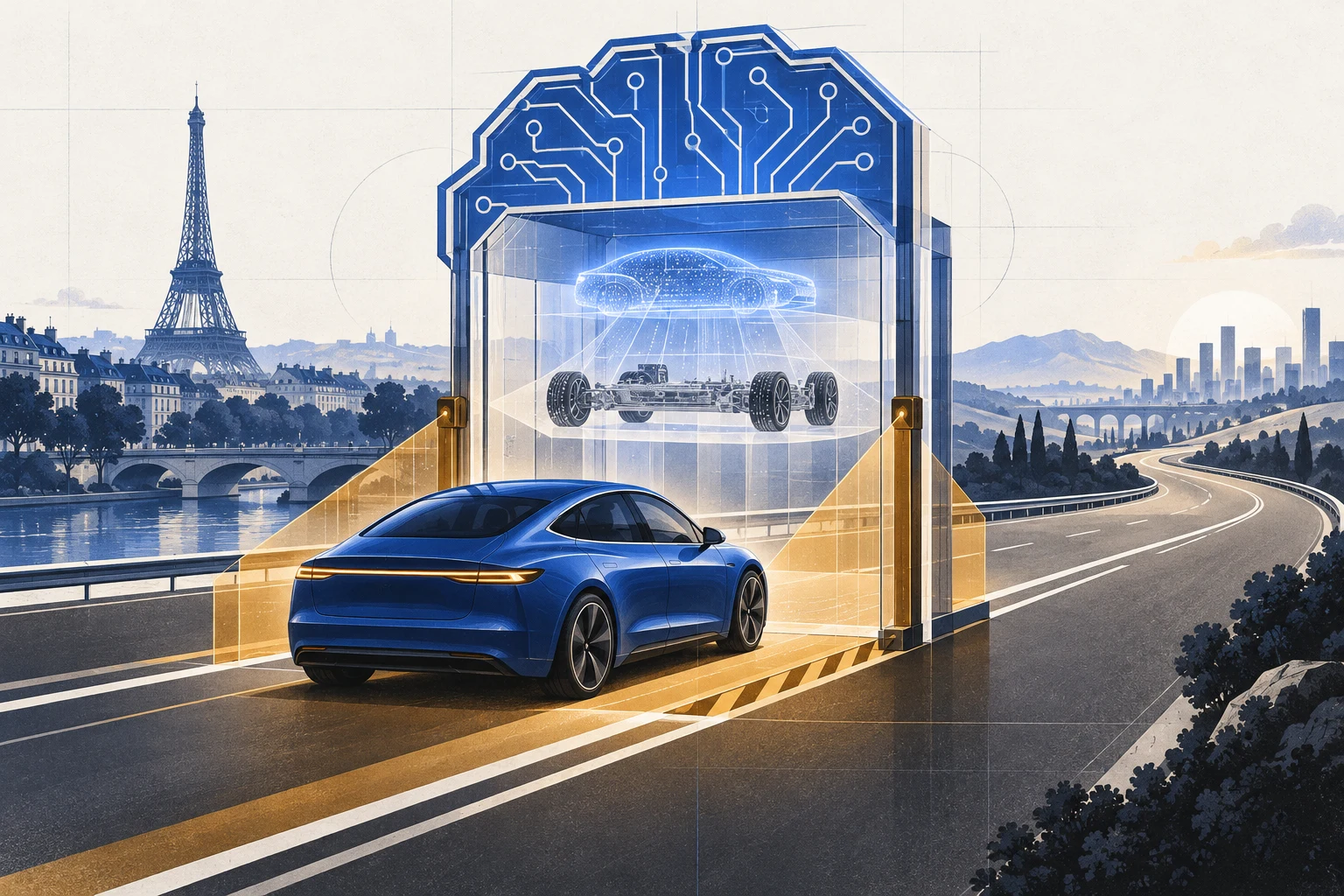
On 22 July, France said it would not recognise Tesla's FSD Supervised system in its existing form. The objections were specific: speed behaviour and whether driver attention is adequately maintained in cities and complex manoeuvres. This was not a permanent ban. France began testing two FSD-equipped cars on public roads in September, and the EU's 6 October committee meeting continued the file without putting approval to a vote.
That distinction matters because FSD Supervised is not an autonomous car. It is a driver-assistance system: it can steer, brake and accelerate, but the person behind the wheel remains responsible and must be ready to intervene. The Dutch RDW approved a European version after more than 18 months of testing and says correct use can improve safety. France asked for more assurance. Both positions can be technologically serious.
The more important industrial question sits underneath the approval fight. If customers increasingly choose vehicles for perception, planning, updates and an AI driving stack, the manufacturer that stamps the body may no longer control the most valuable layer. Europe should not lower its safety standard to move faster. It should make the standard transparent, harmonised and fast enough that regulation tests the brain of the car without becoming a shelter for yesterday's business model.
What the Tesla dispute reveals about Europe's automotive future
1. France paused one approval route; it did not outlaw the technology
The Netherlands granted FSD Supervised a type approval with provisional Dutch validity on 10 April. Other countries then recognised that approval nationally while an EU-wide Article 39 process continued. France declined to do so in July, citing unresolved safety issues, but in September accepted two vehicles for real-road evaluation. The European Commission's 6 October committee agenda listed continued discussion, not a vote. The accurate status is unresolved and evolving - not banned forever.
2. The name promises more than the legal product delivers
Tesla's system performs a wide range of driving tasks, yet it remains supervised assistance. RDW says the driver must always participate in traffic, stay attentive and be able to take over immediately. Germany made the same distinction on 6 October and said Tesla had offered the name Tesla Assisted Driving because Full Self-Driving can mislead users about who is actually responsible. A capable Level 2 system should be judged as Level 2, not marketed in the language of Level 4 autonomy.
3. The safety disagreement is about evidence and operating rules
RDW says it examined the European configuration on tracks and public roads for more than a year and a half and concluded that correct use contributes positively to safety. France focused on contextual speeding and attention monitoring during urban manoeuvres. Tesla has published a detailed safety dashboard, but it is still manufacturer-produced evidence and its European FSD mileage includes an engineering fleet. The right regulatory answer is a reproducible public test protocol, comparable exposure and post-launch reporting - not a contest between a minister's warning and a vendor's headline ratio.
4. Europe already knows the vehicle is becoming a software platform
The European Commission describes software complexity, non-European technology competition and supply-chain dependence as direct threats to the region's automotive position. Its vehicle-of-the-future programme is building common open software components, interfaces and computing architecture for software-defined vehicles. That policy is an admission that mechanical excellence alone is no longer enough. The strategic response to foreign driving software is to build credible European alternatives, not merely delay their arrival.
5. The body-and-brain split is no longer hypothetical
Waymo and Hyundai agreed that Hyundai would manufacture autonomy-ready IONIQ 5 vehicles in Georgia and Waymo would integrate its sixth-generation Driver. Waymo and Toyota are also exploring a new autonomous platform and the use of Waymo technology in personally owned vehicles. These partnerships are sensible ways to combine specialist strengths. They also show how the stack can divide: one company supplies the vehicle, another supplies perception and decision-making. The commercial balance between them is not predetermined.
6. Incumbent failure is not inevitable - and retreat is not disappearance
General Motors stopped funding Cruise's robotaxi programme in December 2024 because scaling required too much time and capital in an increasingly competitive market. It did not abandon automated driving. GM combined technical teams around Super Cruise and advanced assistance for personal vehicles. That is a more useful lesson than saying legacy manufacturers cannot write software: capital allocation, safety incidents, product scope and organisational incentives determine which route survives.
7. The horse analogy explains adaptation, not destiny
US agriculture once devoted 93 million acres to feeding horses and mules, according to a historical USDA summary. When motorisation reduced that demand, some capabilities transferred and others did not. Studebaker moved from wagons into cars and ended horse-drawn production in 1920. The analogy is useful because industries can look healthy while value migrates function by function. It is limited because driving software creates public-road risks that carriage makers never imposed at machine speed; safety review is not automatically protectionism.
8. Europe needs two policies at once
First, approve advanced driving systems only against clear evidence: defined operating conditions, driver-monitoring requirements, legal speed behaviour, independent incident reporting and rapid correction of unsafe updates. Second, treat automotive AI as strategic capacity: shared test infrastructure, access to compute and data under lawful safeguards, portable open components and procurement that lets European stacks reach real roads. Safety without capability creates dependency. Capability without safety transfers the experiment to the public.
The July decision should not be romanticised as France defending its champions or caricatured as bureaucracy costing lives. By October, the file had already moved: France was testing, Germany supported progress under clearer terms, Tesla had published more evidence, and the EU was still debating. That is what a live technical approval process looks like - messy, revisable and slower than a software release.
The real warning for Europe is not that one American feature arrived late. It is that the differentiating layer of the next car may be developed, updated and monetised elsewhere. The answer is neither a rubber stamp nor a wall. It is a faster evidence machine and a stronger domestic software ecosystem, so European safety rules shape the future car instead of merely deciding when somebody else's car may enter.
Where we track this
- The AGI Clock →
A transparent tracker for evidence that moves general-purpose AI capability closer - or farther away.
- AI exposes tasks before it erases occupations →
Why aggregate stability can hide meaningful changes inside specific roles and career entry points.
- The agent harness matters as much as the model →
How tools, controls, feedback and operating constraints turn intelligence into a dependable system.
Questions people ask
- Is Tesla FSD legal in France?
- Not for ordinary customer use as of 11 October 2026. France declined to recognise the provisional Dutch approval in July, then began evaluating two FSD-equipped vehicles on public roads in September. An EU-wide decision has not yet been adopted.
- Is Tesla FSD actually self-driving?
- No. The European FSD Supervised product is an advanced driver-assistance system. It can perform steering, braking, acceleration and other manoeuvres, but the driver remains responsible, must monitor the road and must be ready to take over immediately.
- Why did France object to Tesla FSD?
- France's transport minister identified two main concerns in July 2026: the system's approach to driving above posted speed limits and whether it guarantees sufficient driver attention in urban traffic and complex manoeuvres such as lane changes, intersections and roundabouts.
- Did the EU approve Tesla FSD on 6 October 2026?
- No. The European Commission's published committee record for 6 October showed continued discussion of the Dutch request, not an approval vote. The EU-wide process therefore remained open after that meeting.
- Does delaying FSD protect European carmakers?
- It may delay one foreign competitor, but delay alone does not create European driving software. Durable competitiveness requires both credible safety validation and investment in European software-defined vehicle platforms, computing architecture, AI talent and real-world deployment.
Written 11 October 2026 from an owner-supplied English transcript of a video at youtube.com/watch?v=vdJeU-Vdc5E. The video's central industrial argument was retained, but its regulatory framing and several conclusions were narrowed. RDW's 10 April 2026 explanation confirms a provisional Dutch approval after more than 18 months of testing, states that the European configuration differs from the US product, and explicitly classifies FSD Supervised as driver assistance with the driver remaining responsible. France's 22 July position was checked against the transport minister's official Agora response as reproduced by multiple reports: the objections concerned speed behaviour and driver attention during complex urban manoeuvres. The later status was updated using Philippe Tabarot's 2 September statement that France had accepted two vehicles for on-road tests and the European Commission's Comitology Register for the 6 October TCMV meeting, which records continued discussion rather than a vote. Germany's Federal Ministry of Transport confirmed on 6 October that the system remained under European review, that Tesla had offered the name Tesla Assisted Driving, and that the driver remains fully responsible. Tesla's Article 39 evidence dashboard was reviewed as manufacturer-provided evidence; its European FSD figures largely describe engineering-fleet validation and are not treated here as independent proof that the system is safer than ordinary driving. The industrial analysis was checked against the European Commission's Digital Vehicle Ecosystem and 2025 automotive action plan, Waymo's official Hyundai and Toyota partnership announcements, and GM's December 2024 decision to stop funding Cruise robotaxi development while combining teams around driver assistance for personal vehicles. The historical comparison uses USDA's 1954 graphic summary for the 93 million acres devoted to horse and mule feed in 1915 and the Studebaker National Museum's timeline for the company's shift from wagons to automobiles. Corrections and limits: France did not impose a permanent ban; the system is not autonomous; no EU-wide vote occurred on 6 October; the Dutch safety conclusion and Tesla's safety ratios do not remove the need for independent, reproducible validation; partnerships that separate the vehicle from the driving stack do not prove that automakers will become commodity suppliers; and the transcript's broader predictions about mass unemployment, social stratification and transhumanism are omitted because they do not follow from the FSD approval record. TaskNorth has no commercial relationship with Tesla, Waymo, Hyundai, Toyota, GM, RDW or the speaker.
Trying to work out which AI tools fit your task? Describe the outcome and get a Blueprint: the tools, the prompt, and the steps, with pricing we verified ourselves.