The Horowitz Andreessen Academy is not replacing college. It is rebuilding the bundle around AI
a16z's new San Francisco fellowship trades a degree for projects, a portfolio and direct access to the technology industry. That is a revealing education experiment - but not yet a replacement for college.
The Horowitz Andreessen Academy will open in San Francisco in September 2027 with about 50 students. Its current offer is a one-year, full-time fellowship: short courses taught by practitioners, long stretches spent building ambitious projects, a period abroad and a summer co-op. The founding class pays no tuition and earns no degree or college credit.
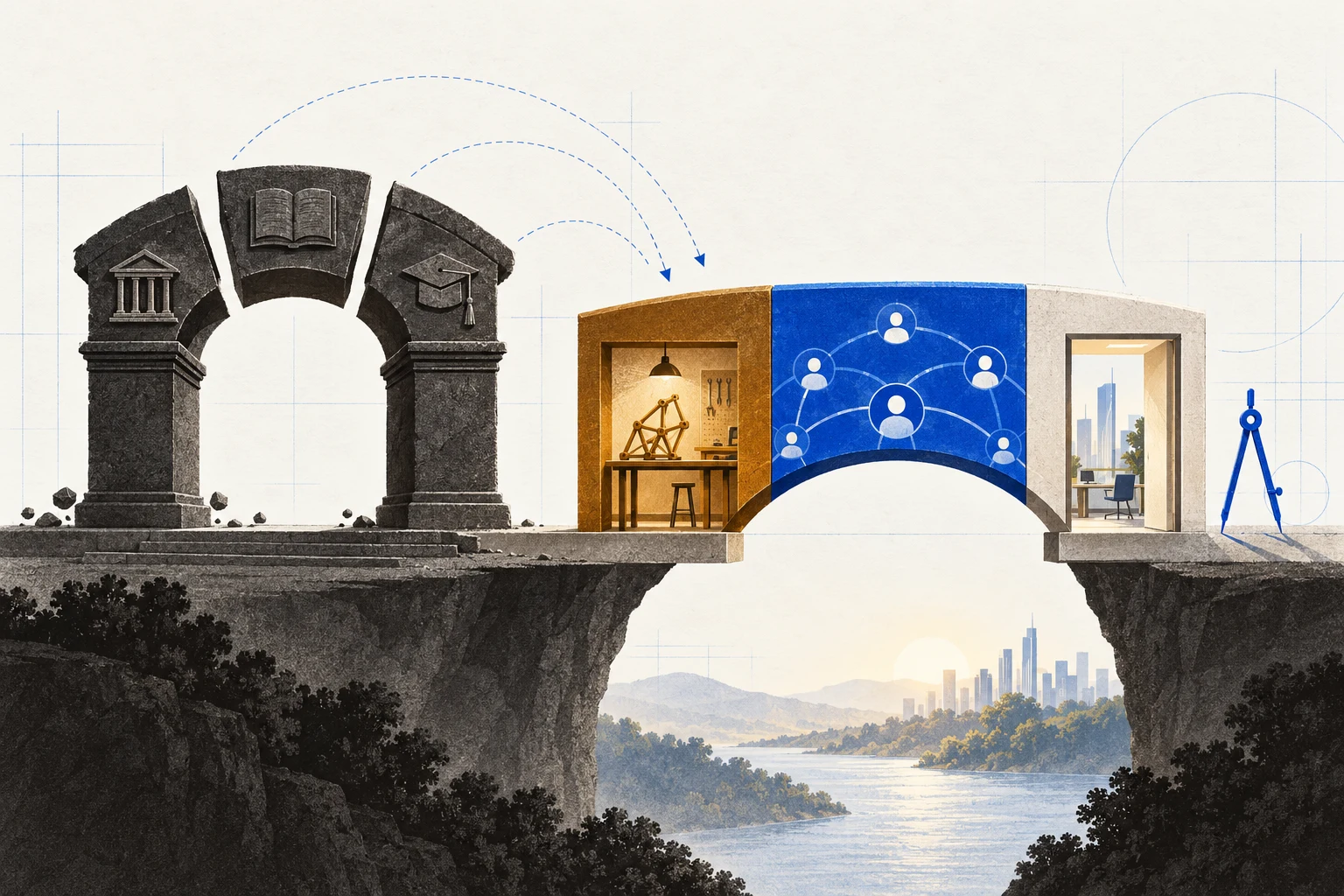
That makes the Academy more interesting than the headline that Silicon Valley wants to replace university. It does not remove the functions people buy from college; it rearranges them. Instruction becomes shorter, projects become the main evidence of ability, and a network of technology companies becomes part of the classroom, equipment supply and route into work.
AI is the reason given for the redesign, but it is not the whole product. The scarce goods here are selection, attention, compute, feedback, collaborators and proximity to employers. The experiment may show that those ingredients can outperform one year of conventional college for a narrow group of self-directed builders. It cannot yet show that the model works for most students - or at scale.
What the Academy changes - and what the launch story leaves unresolved
1. The product enrolling now is a one-year fellowship
The Academy's admissions pages describe one year from September 2027 to August 2028, not a completed two-year college replacement. a16z says a separate two-year programme is intended for autumn 2028, subject to regulatory approval, and is not yet offered or accepting applications. Calling the current programme a two-year university alternative merges an operating plan with a future ambition.
2. It unbundles college instead of making college disappear
A university commonly combines knowledge, a credential, a peer group, access to mentors, personal maturation and a recruiting channel. The Academy keeps most of that bundle but changes the packaging: compact courses, a small cohort, outside practitioners, a portfolio and co-ops. What it removes is the accredited degree. Its own FAQ says college remains a good option for most students and encourages applicants to keep both paths open.
3. AI makes execution cheaper, so judgment becomes more visible
The Academy's thesis is captured by Erik Torenberg's line that the internet made it possible to know anything while AI makes it possible to do anything. The second half is still an exaggeration, but the direction matters. When models can explain concepts, generate code and help prototype quickly, a school can spend less time testing recall and more time testing whether a student can choose a worthwhile problem, evaluate the output and finish something useful.
4. 'Proof of work' changes the signal, not the need to select
Applicants are asked to show what they have built, investigated, organised or shipped. That can reveal initiative more directly than an essay about future potential. Yet the application also requests a transcript and any available test scores, and admission is explicitly highly selective. The Academy is replacing one admissions emphasis with another - not opening a path without filters.
5. A portfolio is valuable only when the market trusts it
Students are meant to leave with a body of work rather than a certificate. In software, design or entrepreneurship, a strong project can sometimes communicate ability better than a grade. But degrees travel across industries, countries and decades because institutions recognise the signal. An Academy portfolio may be powerful inside the technology network surrounding the programme and much less legible outside it. That portability has to be demonstrated.
6. The partner network is both the advantage and the dependency
Founding partners include Anthropic, Google, Meta, NVIDIA, OpenAI, Palantir, Stripe, Coinbase, Replit and Anduril. The Academy says partners can help shape curriculum and provide compute, hardware, mentors and co-op opportunities. That access is difficult for an ordinary school to reproduce. It also means the model's value may come as much from a16z's network as from a general breakthrough in teaching, and a co-op opportunity is not a guaranteed job.
7. Tuition-free does not mean cost-free
The founding class will not pay tuition, and a16z says each student will receive more than $50,000 in compute credits plus a $5,000 travel and research budget. Students remain responsible for housing, meals and personal expenses in San Francisco. The Academy estimates shared dorm-style housing at roughly $1,600 to $1,800 per month and says it intends to offer need-based help. Access will depend on how much of the full living cost that aid actually covers.
8. Proof of work can reward opportunity as well as talent
A teenager with a laptop, spare time, technical parents and experienced mentors has had more chances to assemble an impressive portfolio than one working evenings or sharing a device. Project-based selection can identify overlooked builders, but it can also convert prior access into apparently neutral evidence of merit. A serious alternative to college should publish who applies, who is admitted, who receives support and which students thrive after the programme.
9. Fifty selected builders cannot settle the future of university
A small, motivated cohort in San Francisco may learn quickly because the students are unusually self-directed, the staff can give intense attention and the partners offer rare resources. Those are features, not flaws, but they create a selection problem. If graduates succeed, we will still need to separate what the programme taught from what its admissions process and network had already selected. The useful evidence will be multi-year outcomes, not launch-week names.
10. The long-term test is whether the model creates portable agency
The best outcome would not be a collection of demo-day projects. It would be graduates who can keep learning, judge unreliable AI output, collaborate with people outside their cohort and build in domains beyond the current technology cycle. Public outcomes should include completion, employment, further study, companies and research created, student debt avoided and performance after several years. Without that evidence, the Academy is an intriguing prototype, not a verdict on higher education.
The Academy's sharpest idea is that education should be organised around what a student can make with abundant intelligence, not around how much information the student can reproduce unaided. Its weakest implication is that access to AI makes the rest of college obsolete. Human feedback, a credible signal, a demanding peer group and a route into work remain central; a16z is simply assembling them in a different institution.
So the question is not whether fifty young builders can have an exceptional year. With $42 million in backing, expensive compute and access to leading technology companies, they probably can. The question is whether the resulting ability is broader than the network that produced it - and whether any part of the model can become accessible to students who arrive without proof that they already belong.
Where we track this
- AI changes tasks before it removes jobs →
Why education should prepare people for changing bundles of work rather than one fixed occupation.
- Universal AI access is not the same as equal opportunity →
A wider look at what access to capable models can - and cannot - solve on its own.
- What remains valuable when AI gets cheaper →
The human judgment, trust and real-world execution that become more important as generation is commoditised.
Questions people ask
- Is the Horowitz Andreessen Academy accredited?
- No. The Academy says it is an independent, non-accredited programme. The founding one-year fellowship does not award a college degree or college credit; students are expected to leave with a portfolio of work.
- Is the Academy a two-year alternative to college?
- Not yet. The programme currently accepting applications is a one-year fellowship beginning in September 2027. a16z says the Academy intends to seek approval for a separate two-year programme that could begin in 2028, but that programme is not yet offered or enrolling.
- Is the Horowitz Andreessen Academy free?
- The founding class will pay no tuition. Students still cover housing, meals and personal expenses in San Francisco, although the Academy says it intends to provide need-based assistance. a16z says a future approved two-year programme would probably charge tuition comparable to an elite private university.
- What does 'proof of work' mean in admissions?
- Applicants submit a portfolio showing projects, research, software, organisations or other work they have actually completed, along with a video, transcript and any available test scores. The Academy says the portfolio receives heavy weight, but it does not eliminate academic records from the application.
- Who can apply to the founding class?
- Applicants must have completed high school by August 2027. The Academy gives priority to current high-school seniors but also accepts candidates with up to two years of college, international applicants and applicants of any age who meet the education requirement.
Written 5 October 2026 from an owner-supplied French commentary and The Wall Street Journal's report The Tech Elite Is Funding an Alternative to College. Programme dates, the approximately 50-person cohort, the San Francisco campus, the one-year structure, the period abroad, the co-op, eligibility, proof-of-work admissions, required transcripts, founding-class tuition, living-cost responsibility, estimated housing costs, need-based-aid intention, non-accredited status and absence of a degree or college credit were checked against the Horowitz Andreessen Academy's official home, programme, admissions and FAQ pages. The partner list and the description of how partners may support curriculum, equipment, mentors and hiring were also checked there; official language describes opportunities and consideration, not guaranteed placements. The Academy itself says college is a good option for most students. The curriculum examples, $42 million raise, $50,000-plus compute allocation, $5,000 travel and research budget, lack of traditional grades and tests, and the intention to seek approval for a separate two-year programme were checked against a16z's 22 September 2026 launch article and incubation announcement. a16z says that proposed two-year programme is not yet offered or enrolling, could begin in autumn 2028 subject to approval, and would probably charge tuition comparable to an elite private university. The article therefore does not describe the current fellowship as an accredited two-year replacement for college. The analysis of selection effects, portfolio portability, unequal access to prior opportunities and the Academy's role as a possible talent pipeline is TaskNorth's interpretation, not a claim made by the Academy or its partners. TaskNorth has no commercial relationship with the Academy, a16z, the named partners or The Wall Street Journal.
Trying to work out which AI tools fit your task? Describe the outcome and get a Blueprint: the tools, the prompt, and the steps, with pricing we verified ourselves.