Forget universal basic income, give everyone AI credits instead
A tech investor calls UBI “communism” and proposes universal AI access instead. We checked the claims, including one that quietly undercuts his own argument.
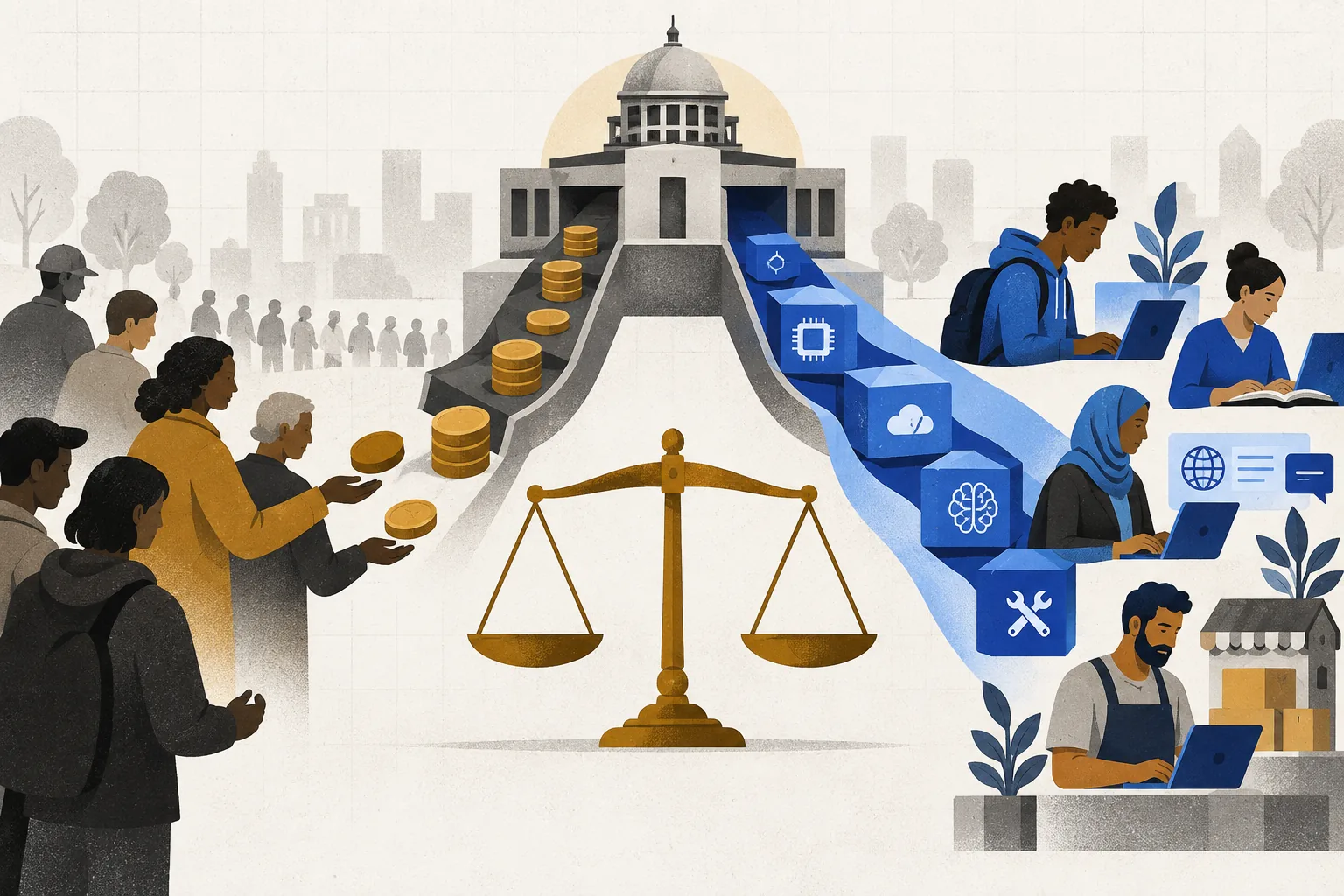
In a French-language interview, an investor dismisses the universal basic income being floated by tech leaders as “absolutely ridiculous”, and proposes something else: universal access to AI itself. Not cash, but tokens. His argument is that a laid-off worker doesn’t need beach money, they need the same tools an engineer has, and governments obsessing over sovereign data centres are missing the point.
The strongest part is a scenario worth sitting with. You lose your job to automation, unemployment payments shrink, and the €20 or €200 a month for the AI tools that might help you reinvent yourself becomes the first thing you cut. Your capacity to rebuild becomes a function of how many tokens you can afford, a “digital desert” where the people who most need leverage have the least access to it. That is a real mechanism, and it is not solved by a cash transfer alone.
The weaker parts are where he reaches for history. Here is what checks out and what doesn’t.
The fact check
“We tried it, it’s called communism, it didn’t work”
Wrong on both counts. Universal basic income is a cash transfer, not collective ownership of production, and it has been tested in controlled trials rather than merely asserted. Finland paid €560 a month to 2,000 unemployed people for two years; the result was small employment effects with clearly better mental wellbeing and perceived economic security.
The evidence is more specific than either side admits
A three-year study paying $1,000 a month, published by OpenResearch, found recipients worked 1.3 hours less per week and were 2 points less likely to be employed, but 10% more likely to be actively job-hunting, with Black recipients 26% more likely to start a business and problematic drinking down 20%. Modest work reduction, more risk-taking, better health. Neither utopia nor collapse.
The irony: his alternative is already Altman’s proposal
He attacks tech leaders for pushing cash handouts, but Sam Altman said on the All-In podcast: “I wonder if the future looks something more like Universal Basic Compute than Universal Basic Income, and everybody gets like a slice of GPT-7 compute.” The distribute-access-not-cash idea he presents as the sharp alternative is one the people he is criticising already put on the table.
“AI will create new jobs”, plausible, unproven
The farm-to-factory analogy is the standard argument and it has historically held, but past transitions are evidence about the past. He concedes the real problem himself: retraining takes about two years while the technology moves in eighteen months. That gap is the whole policy question, and analogy doesn’t close it.
The pricing detail is accurate
The €20 and €200 tiers he cites match what mainstream assistants actually charge, which makes his affordability point concrete rather than rhetorical, the difference between the cheap tier and the capable one is real money for someone out of work.
Read charitably, the argument isn’t really UBI versus AI access; it is that access is the part nobody is funding. Governments are pouring billions into compute sovereignty while nobody guarantees the unemployed person a working seat at the tools. You can believe cash support is necessary and still think that gap matters.
This is an opinion piece, one investor’s view, translated from French and summarised here. Forecasts about which jobs disappear are contested by serious people on both sides, and nothing above should be read as a prediction of what your work will look like in two years.
Questions people ask
- Has universal basic income actually been tested?
- Yes, in controlled trials. Finland ran a two-year experiment paying €560 monthly to 2,000 unemployed people, finding small employment effects and improved wellbeing. A separate three-year US study paying $1,000 a month found slightly reduced work hours alongside more job-searching and more business formation among some groups.
- What is universal basic compute?
- The idea of distributing AI capacity rather than cash. Sam Altman raised it publicly, suggesting the future might look “more like Universal Basic Compute than Universal Basic Income,” with everyone receiving a share of a future model’s compute to use, sell or donate.
- Does AI create more jobs than it destroys?
- Historically, technological transitions have created new categories of work, but that is evidence about previous shifts rather than proof about this one. The live disagreement is about speed: retraining typically takes years, while capability changes arrive in months.
Summarised from a French-language interview; the argument and characterisations are the interviewee’s, not ours. Verified independently: Finland’s basic income experiment (Kela/Finnish Ministry of Social Affairs and Health, 2017–2018, €560/month, 2,000 participants); the three-year $1,000-a-month unconditional cash study published by OpenResearch; and Sam Altman’s universal-basic-compute remarks on the All-In podcast, quoted as reported by Business Insider. Claims we could not verify are described as the speaker’s view rather than repeated as fact.
Trying to work out which AI tools fit your task? Describe the outcome and get a Blueprint: the tools, the prompt, and the steps, with pricing we verified ourselves.