Apple is not trying to win the model: the iPhone 18 Pro, Siri AI and the fight to own the moment intent becomes action
A 2-nanometer chip, a five-model ladder from your pocket to Nvidia GPUs in Google Cloud, and an assistant that reaches into your apps. The strategy is coherent. The one number nobody quotes says the hardest part is still failing two times in three.
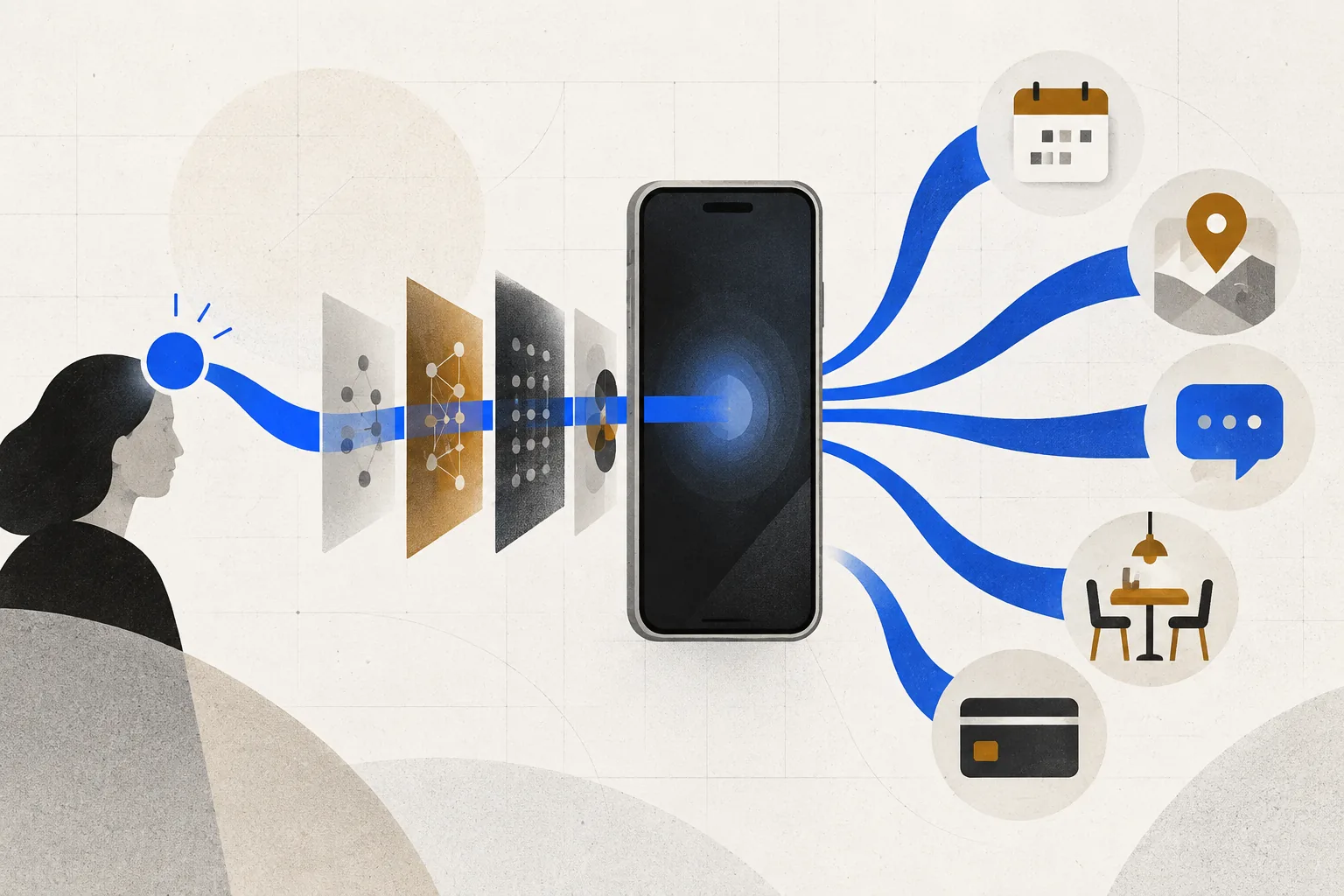
Apple shipped the iPhone 18 Pro on 14 September 2026 and, the same day with iOS 27, the rebuilt Siri AI, as a beta in English only. Read the two announcements together and a strategy shows through that has little to do with cameras. Apple is not trying to own the best model. It is trying to own the moment your intention turns into an action inside your apps.
The pieces line up. A20 Pro is Apple's first 2-nanometer phone chip, with 50 percent more memory bandwidth than A19 Pro and 32 Neural Engine cores for double the AI throughput, which is compute you bought rather than compute Apple rents. Above it sits a published ladder of five models, and above that a cloud tier that now runs on Nvidia GPUs inside Google Cloud.
What Apple is assembling is the layer between an instruction and its execution: personal context, on-screen awareness, and the app actions developers expose to the assistant. Whoever holds that layer decides which options reach you, and the model underneath becomes a supplier. The catch is that coordinating several apps reliably is exactly where measured performance is still worst.
What Apple announced, what the primary sources verify, and where the bet can still fail
1. What actually shipped, and what it is not yet
iPhone 18 Pro and 18 Pro Max went on sale 14 September 2026 at $1,199 and $1,299. Siri AI arrived the same day with iOS 27, and Apple's own newsroom describes it as a beta, in English only. Announced capabilities: personal context across messages, email and photos, on-screen awareness, and actions inside apps. Treat the assistant discussed everywhere this month as a first-language beta rather than a shipped daily habit, because the gap between those two things is where Apple's previous Siri attempt died.
2. The chip claims, in Apple's own words
From the iPhone 18 Pro release: A20 Pro is built on 2-nanometer process technology, its 6-core CPU has integrated Neural Accelerators, its new 7-core GPU is up to 40 percent faster than A19 Pro, and it carries a Dual 16-core Neural Engine, 32 cores in total, for double the AI processing power of A19 Pro, with 50 percent more memory bandwidth. The memory-bandwidth figure is the one that matters for an assistant, since feeding a model is usually the bottleneck before arithmetic is. All of these are vendor figures with no independent benchmark attached.
3. The model ladder Apple published, which is what local-plus-cloud concretely means
Apple's machine-learning research blog, 8 June 2026, names five: AFM 3 Core, a 3-billion-parameter dense model on device; AFM 3 Core Advanced, a 20-billion-parameter sparse model on device that activates only 1 to 4 billion parameters per request and is natively multimodal; AFM 3 Cloud and ADM 3 Cloud for image work on Private Cloud Compute; and AFM 3 Cloud Pro, in Apple's words the most capable server model, powering the most demanding use cases like agentic tool use and complex reasoning. Quantization-aware training is what makes the on-device pair fit a phone's memory and power budget.
4. The heaviest work does not run on Apple silicon, and Apple says so
Four of those five models were optimised for Apple silicon. AFM 3 Cloud Pro was optimised for Nvidia GPUs, and Apple states it worked with Google and Nvidia to extend Private Cloud Compute to Nvidia GPUs in Google Cloud. Apple's security blog details the stack: Nvidia Confidential Computing, Intel CPUs with TDX, and Google's Titan chip, with attestation rooted in at least two independent vendors. Read the status line before treating the privacy guarantees as settled: that tier is in a preview period, with protections described as gradually ramping. So it is not just two kinds of chip cooperating, it is two companies' clouds.
5. Why the cost of use, not the cost of training, is the number to watch
Deloitte estimates that inference takes about two thirds of all AI compute in 2026, roughly double its share of a few years ago, up from about a third in 2023. Gartner, measuring spend rather than cycles, puts inference at around 55 percent of a $42 billion AI-optimised infrastructure market this year. Both are estimates, not measurements, and they disagree because they count different things. The strategic consequence holds either way: every request a phone answers by itself is a server call Apple never pays for, which is why pushing work on device is an economic decision before it is a privacy one.
6. The Google deal, stated precisely
Announced 12 January 2026: a multi-year, non-exclusive agreement for Apple to build on Google's model technology. Apple's statement was that after careful evaluation it determined Google's technology provides the most capable foundation for Apple Foundation Models, and its June blog says the new models were custom-built in collaboration with Google. The roughly $1 billion per year figure is reported, not confirmed by either company, and the same goes for the parameter counts circulating for the custom model. Apple had reportedly evaluated OpenAI and Anthropic first. Note what is not happening: the models run on Apple's own infrastructure, not as a Google consumer product with Google branding.
6. The Google deal, stated precisely: verified pricing, fit and cautions →
7. The money flows both ways, and one direction is now legally constrained
Google paid Apple $20 billion in 2022 to remain Safari's default search engine, a figure confirmed by unsealed court documents in the US antitrust case and attributed to testimony by Apple's Eddy Cue. That is the distribution rent the strategy rests on, and it is no longer unconditional: in the remedies phase Judge Mehta allowed the payments to continue but barred exclusivity, stopped Google from preventing Apple promoting rivals, and limited default arrangements to twelve months. Access to Apple's users is still worth paying for. It is just no longer something either side can lock down for a decade.
8. The measured hard part, which is the whole bet
iOSWorld, published June 2026, is a simulator benchmark with 133 tasks across 26 purpose-built iOS apps and a persistent user identity: 27 single-app tasks, 60 multi-app tasks spanning two to eight apps, and 46 memory and personalisation tasks. The best configuration evaluated reached 52 percent overall and just 37 percent on the multi-app tasks. Giving frontier models privileged access to the accessibility tree rather than pixels alone added up to 26 points, which tells you how much of the difficulty is simply seeing the interface. Siri AI is not among the systems evaluated and the apps are purpose-built rather than real, so this is a gauge of how hard the problem is, not a score for Apple.
9. The install-base figure everyone repeats, corrected
Apple's current disclosure is more than 2.5 billion active devices, reported for the quarter ended December 2025. That is devices, not iPhones. The last specific active-iPhone number Apple itself gave was 1 billion, in January 2021. So the familiar more-than-a-billion-iPhones line is plausible and probably conservative today, but it is a five-year-old company figure rather than a current one, and the honest version of the scale argument uses the 2.5 billion device number with the right noun attached.
The strategic claim underneath all this is the same one we made on Saturday about OpenAI selling workflow rather than intelligence, one layer closer to your pocket. A model can be swapped, as Apple has just demonstrated by adopting a partner's technology after its own architecture fell short in 2025. What cannot be swapped cheaply is the position: the daily contact point, the personal context, and the catalogue of app actions the assistant is allowed to trigger. Apple is buying capability and building position.
Which puts the uncomfortable question where it belongs. If you ask for a restaurant on Friday under 40 euros a head, something has to choose which three options reach you, and that choice is worth money to whoever wants to be in the shortlist. That is a real shift in commercial power, and it is worth watching early rather than after it feels normal. Just don't mistake the trajectory for the timetable: an English-only beta and a 37 percent success rate on multi-app tasks is not yet a reflex anyone has.
Where we track this
- The model gets cheap, the switch does not →
The same argument in enterprise form: why a lab defends its position in your workflow rather than its lead in the model, with the enterprise spending data that tests it.
- What an agent harness actually is →
The plumbing behind on-screen awareness and app actions: how a model gets tools, context and permission to act, which is the part Apple is building.
- Why cheaper AI makes bigger bills →
The economics behind the inference shift: per-request costs fall while total spend climbs, which is why where a request is computed became a strategic question.
Questions people ask
- Is the new Siri available now?
- Partly. Siri AI shipped on 14 September 2026 with iOS 27, and Apple describes it as a beta available in English only. The announced capabilities are personal context drawn from messages, email and photos, awareness of what is on screen, and triggering actions inside apps. Wider language support and the full feature set have no published date, and Apple's previous attempt at a personalised Siri was announced in 2024 and delayed in March 2025 after its first architecture failed Apple's own quality bar.
- Does Apple Intelligence run on my iPhone or in the cloud?
- Both, and the split is now documented. Two models run on the device: AFM 3 Core at 3 billion parameters and AFM 3 Core Advanced, a 20-billion-parameter sparse model that activates 1 to 4 billion at a time. Heavier requests go to Private Cloud Compute, where AFM 3 Cloud handles general server work and AFM 3 Cloud Pro handles agentic tool use and complex reasoning. That top tier runs on Nvidia GPUs inside Google Cloud, a configuration Apple has published and which is currently in preview.
- Is Siri powered by Google Gemini?
- Apple's new foundation models were, in Apple's own words, custom-built in collaboration with Google, under a multi-year, non-exclusive agreement announced on 12 January 2026. Apple said Google's technology provides the most capable foundation for Apple Foundation Models. The often-quoted $1 billion a year has not been confirmed by either company. Practically, this is not the Gemini app on your iPhone: the models run on Apple's own on-device silicon and Private Cloud Compute, without Google branding in the interface.
- Can an AI assistant reliably chain several apps together today?
- Not reliably. On iOSWorld, a June 2026 benchmark of 133 tasks across 26 iOS apps, the best configuration evaluated succeeded on 52 percent of tasks overall and only 37 percent of the tasks spanning two to eight apps. Siri AI was not among the systems tested, so this is not a verdict on Apple, but it is the clearest public measure of the specific problem Apple's strategy depends on solving, and it says single-app help works far better today than delegating a whole errand.
Written 21 September 2026 from an owner-supplied French video essay; every figure was checked against primary sources on 21 September 2026. Verified directly: Apple's iPhone 18 Pro newsroom release for the A20 Pro claims (2-nanometer process, 6-core CPU with integrated Neural Accelerators, 7-core GPU up to 40 percent faster than A19 Pro, Dual 16-core Neural Engine totalling 32 cores, double the AI processing power, 50 percent more memory bandwidth), the 14 September availability, the $1,199 and $1,299 prices and the description of Siri AI as an English-only beta on iOS 27; Apple's machine-learning research blog of 8 June 2026 for the five-model ladder, the 3-billion and 20-billion-parameter on-device models, the 1-to-4-billion sparse activation, quantization-aware training, AFM 3 Cloud Pro for agentic tool use, and the statement that the models were custom-built in collaboration with Google and that Cloud Pro was optimised for Nvidia GPUs; Apple's security blog for Private Cloud Compute on Google Cloud (Nvidia Confidential Computing, Intel TDX, Google Titan, two independent roots of trust) and for its preview status; the iOSWorld paper for 133 tasks, 26 apps, the 52 percent overall and 37 percent multi-app results and the 26-point gain from accessibility-tree access; and Apple's Q1 FY2026 disclosure of more than 2.5 billion active devices. Reported rather than confirmed, and labelled as such: the roughly $1 billion per year Apple pays Google, the parameter counts circulating for the custom model, and Apple's prior evaluation of OpenAI and Anthropic. Corrections to the source material: the assistant is a beta in one language, not a general rollout; the active-device figure is 2.5 billion devices, while Apple's last specific active-iPhone number, 1 billion, dates from January 2021, so the more-than-a-billion-iPhones framing is not a current Apple figure; the two-thirds inference share is Deloitte's estimate, and Gartner's spend-based cut of the same year gives about 55 percent, so the figure is an estimate with a visible spread rather than a measurement; the transcript's garbled chip comparison is A20 Pro against A19 Pro; and the Google search payment, correctly given as $20 billion for 2022, now carries a condition the video omits, since the US remedies ruling barred exclusivity and capped default arrangements at twelve months. The Private Cloud Compute privacy properties are Apple's own design claims, verifiable in principle through its published transparency programme but not independently confirmed here. The dinner-booking scenario and the influence-over-choice argument in the closing are the source's speculation and our analysis respectively, not anything Apple has announced. Disclosure: TaskNorth's knowledge base holds records for Google Gemini and recommends Claude models, and Google and Apple are both vendors we rate.
Trying to work out which AI tools fit your task? Describe the outcome and get a Blueprint: the tools, the prompt, and the steps, with pricing we verified ourselves.