SEO, AEO, GEO, AIO. Most of the acronyms are noise, and one number should worry you
A widely shared video walks through the new search acronyms and concludes they are all just SEO wearing new hats. That conclusion is half right, and the half that is wrong is the expensive half.
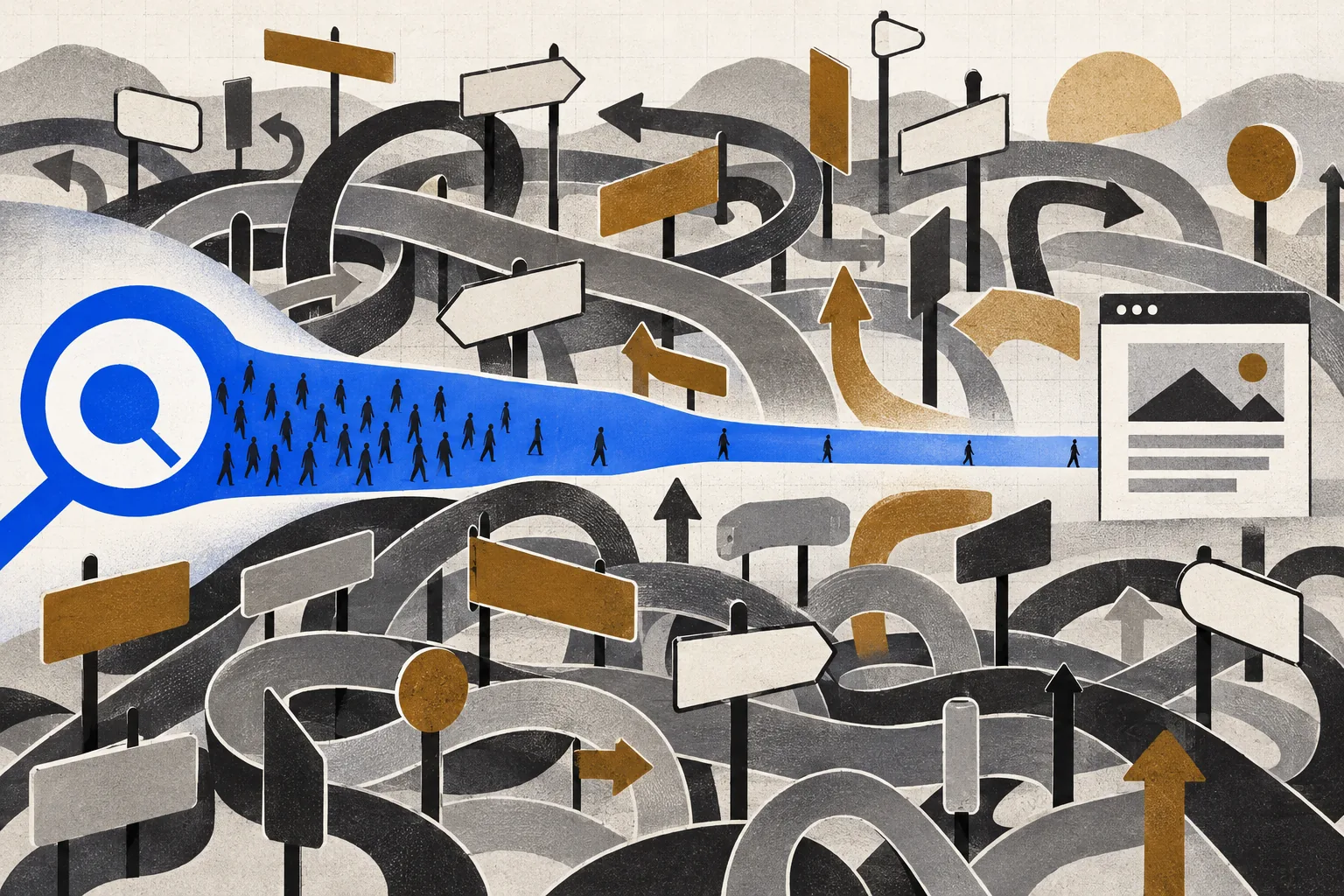
Four acronyms are now sold as four disciplines. SEO optimises for search engines, AEO for answer engines such as Google's AI Overviews, GEO for generative engines that write a paragraph and cite their sources, and AIO for artificial intelligence optimisation generally, a term made worse by the fact that most of the industry already uses AIO to abbreviate AI Overviews themselves.
The video this article is built from works through all four and lands on a defensible verdict: the tactics overlap so heavily that the labels are mostly marketing, and the honest description is modern SEO rather than four separate budgets. On the question of whether you need four agencies, that is correct, and it is worth saying out loud.
Where it ages badly is the reassurance that follows. The measured link between ranking on Google and being quoted by an AI has weakened sharply, the one classic tactic anyone has tested against generative engines actively hurt, and the video's most consequential factual claim was already out of date when it was recorded.
What the acronyms mean, what the measurements show, and where the source needs correcting
1. The four terms, and why one of them is worse than useless
SEO is optimising to rank a page. AEO, answer engine optimisation, targets the box that answers without a click. GEO, generative engine optimisation, targets being quoted inside a generated paragraph. AIO is the loose one, and it collides directly with the industry's own shorthand for AI Overviews, so a sentence containing it usually needs rewriting before it means anything. Three describe a real difference in surface. The fourth mostly describes a sales deck.
2. Correction: AI Overviews launched in France on 22 July 2026
The video tells a French audience that AI Overviews are not yet deployed in France and treats the whole subject as a warning about the future. Google began the rollout of both AI Overviews and AI Mode in France on 22 July 2026, progressively across mobile and desktop, with wider query coverage reported as arriving through the end of September 2026. France had been the last major market without the feature, held up by a neighbouring-rights dispute with publishers. For the audience this was recorded for, that inverts the timeline from preparation to catching up.
3. The 75% figure is not a published number, and the real ones are worse
The video says AI Overviews capture up to 75% of traffic on some United States queries. We could not find that figure in any published study. The measurements that do exist point the same way without needing help. Pew Research tracked 68,879 real Google searches from 900 United States adults in March 2025: when an AI summary appeared, 8% of visits produced a click to a website, against 15% when it did not, and 1% of visits produced a click on a link inside the summary. Google publicly disputed that study. Separately, 68.01% of United States Google searches ended without any click in the first four months of 2026.
4. The claim that ranking is the foundation is the part under most pressure
This is the video's central reassurance and it is the weakest link in the argument. Ahrefs analysed 863,000 keywords and 4 million AI Overview URLs and found that 38% of cited pages also ranked in Google's top ten for the same query, with roughly 31% ranking between 11 and 100 and another 31% not ranking in the top 100 at all. Its own earlier study put the figure at 76%. If you cannot be cited without ranking, most citations should not be coming from pages that do not rank.
5. Read that drop carefully, because Ahrefs itself does
Every article quoting 76% falling to 38% as a clean trend is misquoting the source. Ahrefs states that its parsing improved between the two studies, so it now detects citations it previously missed, the datasets are not directly comparable, and some of the fall reflects better measurement rather than a change in Google's behaviour. That caveat is in the study and almost never survives the retelling. The direction is probably real. The size of it is not established.
6. The vendors disagree with each other by a factor of three
On the same underlying question, BrightEdge reported around 17% overlap between AI Overview citations and the organic top ten in February, a later BrightEdge piece reported 54%, and Originality.AI reported 52%. Ahrefs says 38%. These are not small differences of emphasis; they are incompatible answers, produced by companies that sell visibility tooling and do not publish comparable methods. Treat any single number from this genre as an argument rather than a measurement, including the ones quoted above.
7. What actually tested well, from a paper rather than a video
The GEO acronym comes from a peer-reviewed paper presented at KDD 2024, which is the closest thing to controlled evidence anyone has. Across nine optimisation methods, adding quotations improved visibility by up to 41% on its position-adjusted word count metric, while adding statistics and citing sources each delivered roughly 30 to 40%. Keyword stuffing, the one method carried over intact from classic SEO, performed about 10% worse than doing nothing on Perplexity. Quotes, numbers and sources are cheap to add and they are the tactics with an actual measurement behind them.
8. The best advice in the video is the oldest advice in the video
Its strongest recommendation is to stop fighting for your own brand name and build comparison and alternative pages instead, competing on "alternative to Notion" rather than on a head term you cannot win. That is sound, and it is not new; affiliate and SaaS marketers have done it for a decade. What has changed is why it works. Comparison tables and alternative round-ups are exactly the shape a generative engine can lift a sentence from, which puts this tactic in the same family as adding quotations and statistics.
9. Two claims worth tightening before you repeat them
First, the video says the Google Leaks confirmed user experience as a ranking criterion. What the May 2024 Content Warehouse leak exposed, across 2,596 modules and 16,083 attributes, was NavBoost and its click signals: goodClicks, badClicks and lastLongestClicks over a rolling 13-month window, corroborated by Pandu Nayak's testimony in the United States antitrust trial. Click behaviour is narrower than user experience, and the distinction matters when someone sells you a redesign. Second, the claim that user attention is now under three seconds has no sound source we could find, and it belongs to the same family as the long-debunked eight-second goldfish statistic.
So the video is right about the thing most people get wrong: you do not need four disciplines, four agencies or four budgets, and anyone selling AIO as a separate product line should be asked what it contains. It is wrong about the comfortable part. The fundamentals do not automatically carry you across, because the only tactic anyone has tested that transfers straight from the old playbook is the one that made results worse.
The practical version fits in a sentence. Keep ranking, because it still correlates with citation even if nobody agrees how strongly, and then add the three things with evidence behind them: quote named sources, put real numbers in the text, and cite where they came from. Then measure what you actually care about, which is mentions and qualified visits, not a visibility score sold by the same company that sells the fix.
Questions people ask
- What is the difference between SEO, GEO, AEO and AIO?
- SEO optimises to rank a page in search results. AEO, answer engine optimisation, targets answer boxes such as AI Overviews that resolve a query without a click. GEO, generative engine optimisation, targets being quoted inside an AI-generated answer. AIO is used loosely for AI optimisation and also as the common abbreviation for AI Overviews, which makes it the least useful of the four.
- Is SEO dead?
- No, but the assumption that ranking guarantees visibility is weakening. Ahrefs found 38% of AI Overview citations came from pages ranking in Google's top ten, against 76% in its earlier study, though it warns the two datasets are not directly comparable because its detection improved. Other vendors report figures between 17% and 54% on similar questions, so the honest answer is that ranking still matters and nobody can yet tell you precisely how much.
- Do I need a separate GEO or AEO agency?
- Probably not. The tactics overlap heavily with technical SEO, structured content and digital PR, and a credible provider should be able to show you which specific actions differ from what you already pay for. Ask what they measure, how, and whether the metric is one they invented and also sell.
- Does ranking on Google get me cited by ChatGPT?
- It helps but does not decide it. The published overlap studies disagree sharply with each other, and one analysis of citations across engines found only about 11% of domains cited by both ChatGPT and Perplexity, which suggests each engine builds a substantially different picture of who is worth quoting. Optimising for one is not the same as being visible in all of them.
- How do I get cited by AI systems?
- The strongest published evidence comes from the GEO paper at KDD 2024: adding direct quotations improved visibility by up to 41% on its main metric, while adding statistics and citing sources each gained roughly 30 to 40%. Keyword stuffing did worse than making no change at all. Beyond that, comparison and alternative pages give generative engines a shape they can quote from directly.
Written from an owner-supplied French-language video transcript on the SEO, AIO, AEO and GEO acronyms, checked on 8 September 2026 against primary and named sources. Corrections applied to the source: the transcript states that AI Overviews are not yet deployed in France, when Google began rolling out AI Overviews and AI Mode there on 22 July 2026 with broader query coverage reported through end September 2026; the transcript's figure of up to 75% of traffic captured by AI Overviews does not appear in any study we could locate, and has been replaced with the Pew Research behavioural figures (68,879 Google searches from 900 United States adults, March 2025 data, published July 2025: 8% click-through with an AI summary against 15% without, and 1% clicking a link inside the summary), noting that Google publicly disputed that study; the claim that the Google Leaks confirmed user experience as a ranking criterion is narrowed to what the May 2024 Content Warehouse leak actually showed, namely NavBoost click signals over a 13-month window, corroborated by Pandu Nayak's antitrust testimony; and the claim that attention spans are now under three seconds is unsourced and is flagged rather than repeated. The GEO figures come from "GEO: Generative Engine Optimization" (Aggarwal et al., KDD 2024). Labelled as reported rather than verified: all citation-overlap percentages, which come from commercial SEO vendors including Ahrefs (863,000 keywords, 4 million AI Overview URLs), BrightEdge and Originality.AI, whose published figures range from about 17% to 54% on similar questions and whose methods are not comparable; Ahrefs' own caveat that improved parsing makes its 76% and 38% studies non-comparable is stated in the article because it is routinely dropped elsewhere. The zero-click figure of 68.01% for the first four months of 2026 is likewise vendor-reported. Conflict disclosure: TaskNorth publishes search-optimised articles and its own traffic depends on the mechanisms described here, and every company producing the overlap statistics quoted above sells tooling to improve the metric it measures. The video also promotes the author's paid training programme; nothing in this article evaluates it.
Trying to work out which AI tools fit your task? Describe the outcome and get a Blueprint: the tools, the prompt, and the steps, with pricing we verified ourselves.