Is the AI boom a bubble? What the mid-2026 numbers actually show
Researchers say the hype cycle doesn’t apply to generative AI. We checked that against the latest spending, usage and failure data, and it splits into two very different questions.
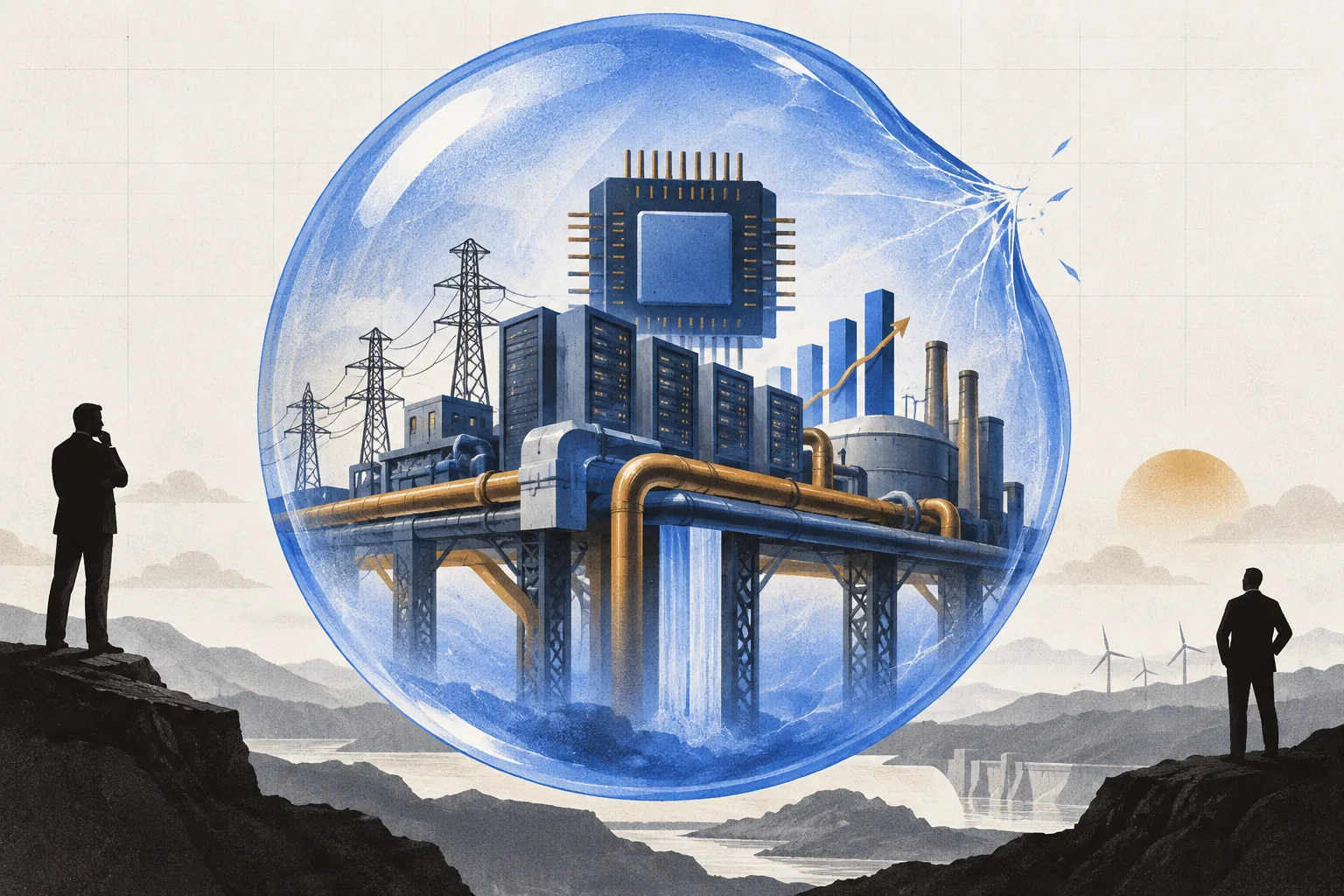
A paper published in Electronic Commerce Research on 9 July 2026 argues that generative AI never entered the “trough of disillusionment” that Gartner’s hype cycle predicts. Its authors, Juan Pablo Mora-López and Olga Rivera-Hernaez of the Universidad del País Vasco, with David Lopez-Lopez of Esade, point to resilient venture funding and continued adoption growth, and conclude the hype-cycle model simply doesn’t describe a technology whose capabilities keep improving mid-cycle.
On demand, the latest numbers back them up. Generative-AI web visits grew 70% year over year to 9.5 billion a month between June 2025 and May 2026, unique visitors rose 57% to 655 million, and app downloads climbed 58% to 4.4 billion. Microsoft said in July that Azure passed $100 billion in annual revenue, up 41%, and that “customer demand continues to exceed available capacity.” Alphabet reported cloud revenue up 82% with a $514 billion backlog.
But “not a hype cycle” and “not a bubble” are different claims, and the second one doesn’t follow from the first. Demand can compound while the spending built to serve it still fails to earn its cost, and the two most uncomfortable numbers in this story sit on exactly that line.
The seven numbers that decide the argument
Usage is still compounding, not plateauing
Up 70% year over year to 9.5 billion monthly visits, with 655 million unique visitors. Whatever is happening in the market, ordinary use is not falling off.
The spending is enormous and still accelerating
Microsoft spent $41 billion in the June 2026 quarter alone, guided to over $50 billion for the next one, and expects roughly $175 billion across calendar 2026. That is one company.
Revenue is real, but concentrated
Anthropic crossed a $47 billion run rate in May 2026 and raised $65 billion at a $965 billion valuation. Alphabet processes about 22 billion tokens a minute. The money is genuine; it is also pooled in a handful of firms.
Most corporate pilots still don’t pay off
MIT’s widely cited study found 95% of generative-AI pilots delivered no measurable return, and blamed integration and workflow, not model quality. Note its age: the fieldwork is from 2025, covering 300+ implementations, and no 2026 successor has been published.
The asset base wears out fast
Microsoft disclosed that “roughly two thirds of our capex was for short-lived assets, primarily CPUs and GPUs.” That is the crux of the bubble argument: chips depreciate on a far shorter schedule than the buildings and fibre that carried previous infrastructure booms.
Increasingly, it is being paid for with debt
Hyperscalers and related firms have issued roughly $225 billion of bonds in 2026, a tenfold jump on last year, and Meta financed one Louisiana campus with a $27.3 billion private-credit deal, the largest ever. Buyers are getting choosier: order books that were roughly five times covered in February were under two times by July, and S&P cut Oracle to BBB- in the same month.
Public markets are already repricing it
CoreWeave still trades far above its March 2025 IPO price but roughly 60% below its June 2025 peak, and Cerebras opened 68% up on its May 2026 debut then gave almost all of it back. Private capital, meanwhile, has never been more concentrated: AI startups raised more in the first quarter of 2026 than in all of 2025, and two thirds of that went into three deals.
So the honest read is that this is two questions wearing one name. Is the infrastructure trade overpriced? Genuinely unresolved, it depends on depreciation schedules and on demand holding up long enough to earn back hardware that ages in years, not decades. Is the technology delivering value to the people using it? That one has an answer, and the MIT study gives it: where returns are missing, the failure is in integration, not capability.
One thing has not happened, and it matters: no data-centre bond, neocloud or hyperscaler has actually defaulted. The stress so far is priced, not realised, wider spreads, a failed $4 billion financing for a CoreWeave-leased site, a downgrade. That is a market repricing risk in the open, which is healthier than one that has not started.
The clearest test is already scheduled: both OpenAI and Anthropic filed confidentially for US listings in mid-2026. Public filings force disclosure of the economics private rounds keep quiet — margins, compute costs, customer concentration. Those documents will settle more of this than any forecast.
Which points to the practical conclusion for anyone who isn’t allocating capital. Your risk is not that the market corrects; it is paying for tools you never wire into an actual process, the exact failure MIT measured. And if a correction does come, the likely effect on you is pricing rather than disappearance: today’s consumer tiers are cheap partly because inference is being subsidised by the same capex under scrutiny. Plan for tools you use hard enough to justify paying full price for.
Questions people ask
- Is the AI boom a bubble?
- Unresolved, and the evidence points both ways. Usage and revenue are growing fast, 70% more generative-AI web visits year over year, Azure past $100 billion, but roughly two thirds of hyperscaler capital spending goes on chips that depreciate quickly, so the buildout has to earn back faster than previous infrastructure cycles did.
- Do most companies actually get a return from AI?
- Most measured pilots have not. MIT’s study of 300+ implementations found 95% delivered no measurable ROI, attributing the failure to poor integration into existing workflows rather than to model limitations. The fieldwork dates from 2025 and no 2026 follow-up has been published.
- How much are big tech companies spending on AI in 2026?
- Microsoft alone reported $41 billion of capital expenditure in the quarter ending June 2026, guided to more than $50 billion for the following quarter, and expects roughly $175 billion across calendar 2026. Alphabet reported an accompanying cloud backlog of $514 billion.
- Is AI usage still growing in 2026?
- Yes. Between June 2025 and May 2026, generative-AI platforms averaged 9.5 billion monthly web visits, up 70% year over year, with unique visitors up 57% to 655 million and app downloads up 58% to 4.4 billion.
- What should a small business do if the AI market corrects?
- Less than you would think. The tools that matter to a small team are cheap subscriptions, not capital commitments, and a correction would most likely raise prices rather than remove products. The bigger risk is subscribing to tools you never integrate into a real workflow.
Sources: Mora-López, Lopez-Lopez and Rivera-Hernaez, Electronic Commerce Research, 9 July 2026, via Esade Do Better; Similarweb generative-AI statistics (29 July 2026, covering June 2025 to May 2026); Microsoft FY26 Q4 earnings materials (July 2026); Alphabet Q2 2026 earnings remarks (22 July 2026); Anthropic Series H announcement (28 May 2026); MIT NANDA research on enterprise generative-AI pilots (2025); IPO prices from CoreWeave and Cerebras announcements with market prices as of 31 July 2026; funding aggregates from PitchBook and Crunchbase; debt-market figures from Fortune reporting of S&P Global data (31 July 2026), Financial Times coverage of Meta’s Hyperion financing, and S&P’s Oracle downgrade (9 July 2026). The OpenAI and Anthropic IPO filings are confidential, so their existence rests on press reporting rather than public documents.
Trying to work out which AI tools fit your task? Describe the outcome and get a Blueprint: the tools, the prompt, and the steps, with pricing we verified ourselves.