Cisco is giving 90,000 employees an AI agent, what the announcement actually says
The rollout is real, but smaller and older than the headlines suggest, and Cisco never linked it to the job cuts everyone connected it to.
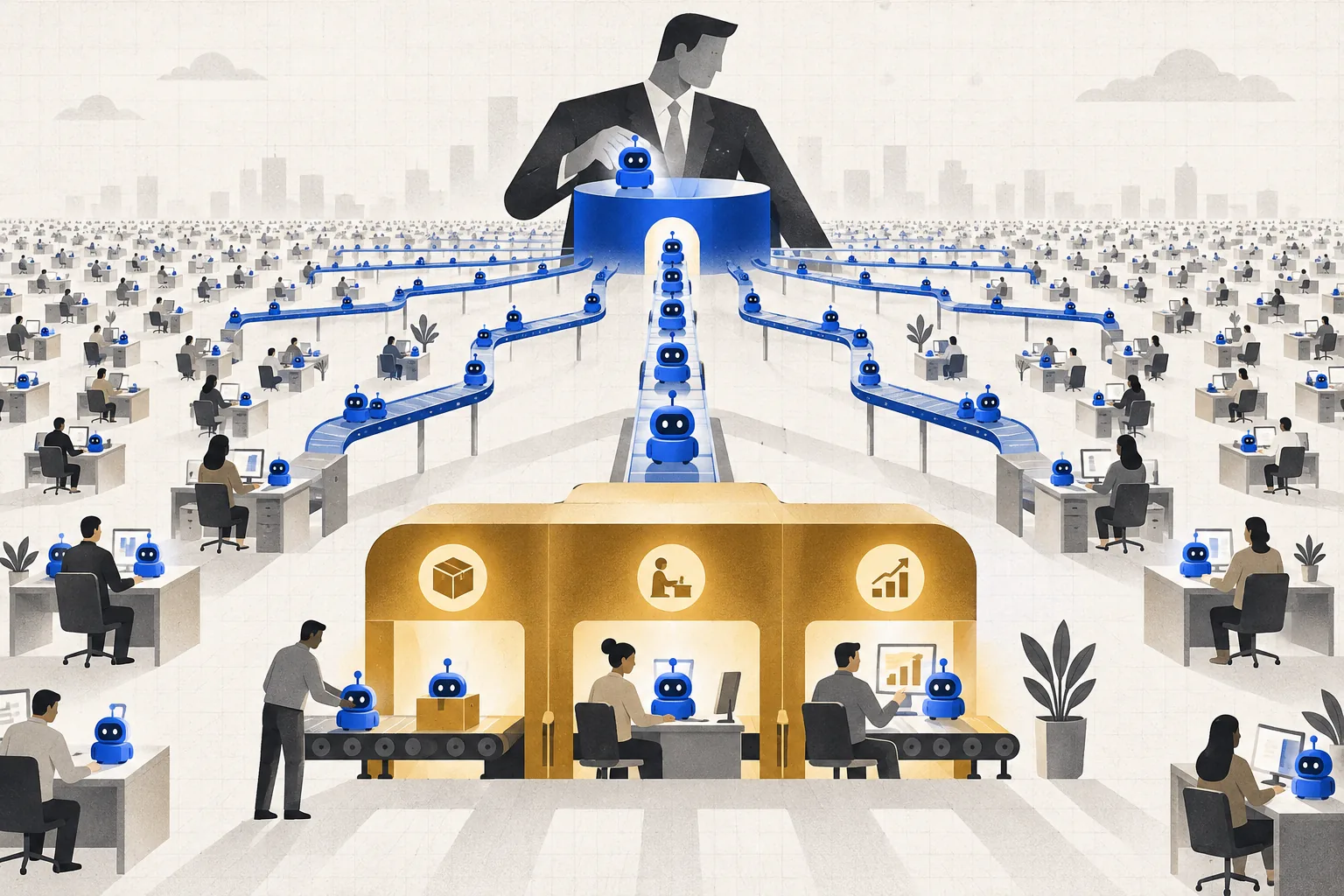
Cisco began rolling out a personalized AI agent to each of its roughly 90,000 employees at the end of July 2026, the start of its 2027 fiscal year. Each agent handles tasks, answers questions, and routes requests to whichever model is cheapest for the job, a deliberate cost design. As CFO Mark Patterson put it, “it’s not going to burn a whole bunch of tokens with frontier models.”
Worth knowing before you read anything else about it: there is no Cisco press release, keynote, or earnings-call announcement. The entire story traces to a single Fortune interview with Patterson on 1 July 2026. Cisco’s own engineering blog, meanwhile, says the internal assistant behind it has run since 2023 and had already served “100,000+ users across our global workforce” by November 2025, more people than the headline figure. So this is an upgrade to a platform that already had full coverage, not a first deployment.
The other thing the coverage added on its own: Cisco announced cuts of “fewer than 4,000 jobs” on 13 May 2026, about ten weeks before the rollout. Cisco has never connected the two, and Patterson described the restructuring as realigning resources rather than saving costs. That link is press inference, which matters, because Salesforce’s CEO did explicitly say agents shrank his support organization from around 9,000 people to 5,000. When an executive means it, they say it.
What is actually established, and what isn’t
Verified: the scale and the timing
Roughly 90,000 employees, with personalized agents starting at the end of July 2026. The source is Patterson’s Fortune interview rather than any Cisco publication, so treat the specifics as an executive’s description rather than documented product detail.
Verified: the platform is three years old
Cisco’s internal assistant launched in April 2023. By November 2025 its engineering team reported more than 45 million interactions, 100,000+ users, and about 156,000 interactions a day. The novelty in 2026 is personalization, an internal agent registry, and cost-aware routing, not the arrival of AI at Cisco.
Verified: the architecture is the interesting part
A largely on-premises orchestration layer routes each request to the best-value model among Azure OpenAI, Claude, Gemini and Cisco’s own Deep Network Model. Cisco’s AI Defense guardrails scan prompts and agent tools for malicious code, sensitive data is redacted before anything reaches a public model, and a registry governs agents that teams build themselves.
Self-reported, and it predates the agents
The widely quoted “73% reported increased productivity, 5 hours saved per week” comes from a Cisco user survey published in November 2025. It is self-reported perception, not measured output, and it describes the older assistant, not the agent rollout it is now used to justify.
Not established: cost, results, or a headcount link
Cisco does not disclose the rollout’s cost, has published no performance metrics for the agents themselves, and has not tied the deployment to the May job cuts. Anyone telling you Cisco replaced 4,000 workers with AI agents is stitching together two separately announced events.
If you don’t run a 90,000-person company, the transferable part isn’t the agents, it’s the plumbing around them. Three of Cisco’s choices scale down to a two-person business almost unchanged: route routine work to a cheap model and reserve the expensive one for genuinely hard tasks; strip sensitive data before anything leaves your control; and keep a written record of which automations exist and who owns them. That last one is the difference between a useful system and a pile of scripts nobody can maintain.
For context, this is a follow, not a first. Deloitte deployed Claude to 470,000 employees across 150 countries in October 2025, five times the scale, nine months earlier. And one caution on timing worth sitting with: Cisco’s California layoff notices took effect roughly two weeks before agents arrived on desks. Whatever the intent, that sequence shapes how staff receive the tool, and adoption is a trust problem long before it is a technology one.
Questions people ask
- Is Cisco replacing employees with AI agents?
- Cisco has not said so. It announced cuts of fewer than 4,000 roles in May 2026 and began rolling out employee AI agents at the end of July 2026, but has never linked the two, and its CFO framed the restructuring as realigning resources. The connection is an inference made in press coverage, not a company claim.
- How many Cisco employees are getting AI agents?
- About 90,000, effectively the whole workforce, starting at the end of July 2026, which is the beginning of Cisco’s 2027 fiscal year. The figure comes from CFO Mark Patterson in a Fortune interview published on 1 July 2026.
- Which AI models does Cisco use internally?
- Several, chosen per request. Cisco’s orchestration layer routes work across Azure OpenAI, Anthropic’s Claude, Google Gemini and Cisco’s own Deep Network Model, selecting on workload, latency and reliability so that routine requests don’t consume expensive frontier-model capacity.
- Has Cisco published results from its AI deployment?
- Only for the earlier assistant, and only as self-reported survey data: 73% of users said their productivity increased and reported an average of five hours saved per week, published in November 2025. No measured results, adoption rates or costs have been published for the 2026 agent rollout.
- What can a small business learn from Cisco’s rollout?
- Copy the design principles rather than the scale: send routine tasks to a cheaper model and save the expensive one for hard problems, remove sensitive data before it reaches any third-party model, and keep a simple register of what each automation does and who maintains it.
Sources: Fortune’s 1 July 2026 interview with Cisco CFO Mark Patterson (the origin of the 90,000-employee figure); Cisco’s engineering blog “Transforming work at Cisco with our internal AI assistant” (17 November 2025) for platform scale, architecture and the productivity survey; Chuck Robbins’ “Our Path Forward” post (13 May 2026) for the workforce reduction; Anthropic’s Deloitte partnership announcement (October 2025) for comparison. Cisco published no press release or keynote for the rollout itself.
Trying to work out which AI tools fit your task? Describe the outcome and get a Blueprint: the tools, the prompt, and the steps, with pricing we verified ourselves.